Admitted Student Yield: 3 Career Content Pieces That Move Decisions
Gen Z students rank career outcomes as a top-three factor in their college decision. Yet most yield campaigns still lead with drone footage of the quad and a list of program rankings. That's a massive disconnect, and it's costing you deposits.
Picture this: a high school senior holds admit letters from three similar universities. Tuition is comparable. Campus visits blurred together. The school that shows her exactly where biology majors land their first jobs, with names and salary ranges, wins. Not because it's a better school. Because it answered the question she actually cared about.
Most Yield Campaigns Ignore the One Thing Students Are Googling
Admissions offices spend months crafting yield communications. Welcome packets, admitted student days, email drip sequences. And the content inside almost always hits the same notes: student life, faculty research, study abroad options. Important stuff. But also stuff that looks identical across 15 competing institutions sitting in the same student's inbox.
Meanwhile, 65% of incoming freshmen say they chose their school primarily based on perceived career outcomes, according to the NACAC Admitted Student Questionnaire. They're not wondering whether your campus has a nice dining hall. They're wondering whether they'll get a job.
The admissions teams seeing the strongest yield numbers have figured out something simple: career outcomes content isn't a career services responsibility alone. It's an enrollment management strategy. And it belongs in every yield touchpoint from March through May 1.
Three Career Content Pieces You Can Build This Month
You don't need a content team of ten or a six-month production timeline. A two-person admissions office can produce these with data that likely already exists somewhere on campus.
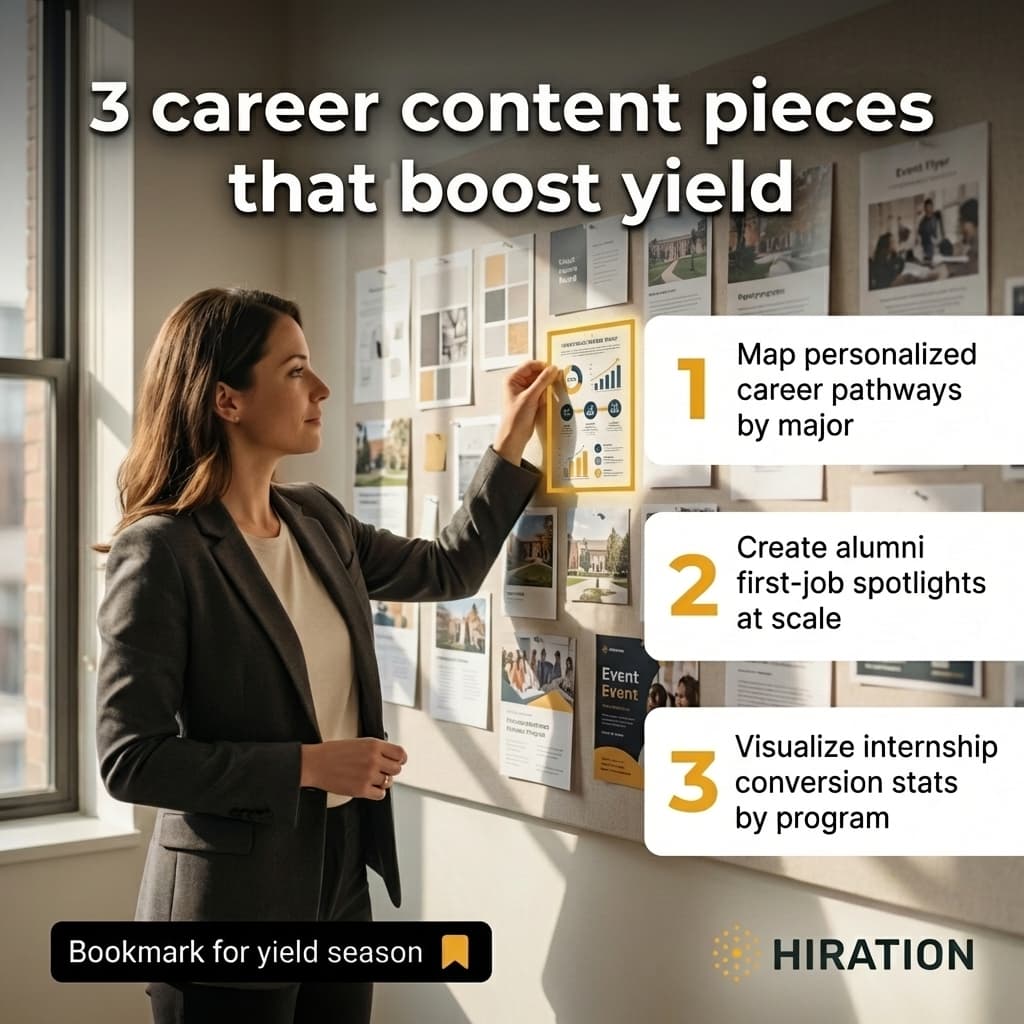
1. Personalized career pathway maps by major.
Take your five highest-enrolled majors. For each one, build a simple visual showing three to five common career paths graduates follow, starting from freshman year through first job. Include real milestones: typical sophomore internship, junior practicum, senior capstone, first employer. Send the relevant map to each admitted student based on their intended major. A psychology admit gets the psychology pathway. A business admit gets theirs. This takes a shared spreadsheet with your career center and a designer who can templatize one layout across all majors.
2. Alumni first-job spotlight series.
Forget the alumni who are 20 years into their career running a Fortune 500 division. Admitted students can't relate to that. They want to see someone who graduated two years ago and just landed their first real role. Collect five-sentence written spotlights from recent grads. Name, major, first job title, company, one sentence on how their college experience connected to getting hired. Batch-produce 15 of these in a single afternoon using a Google Form sent to your alumni relations office. Drop two per week into your admitted student email sequence.
3. Internship and job placement stats, visualized by program.
Your career center almost certainly tracks first-destination survey data. Most schools bury it in a PDF on a sub-page nobody visits. Pull the highlights out. Turn "87% of nursing graduates had a job offer before graduation" into a bold, shareable graphic. Do this for every program where the numbers look strong. If a program's numbers aren't great, skip it for now. You're building a highlight reel, not an audit.
Why Admissions and Career Services Need to Build This Together
The biggest obstacle isn't production capacity. It's the organizational wall between admissions and career services. At many institutions, these offices share almost no data and coordinate on zero campaigns. Admissions doesn't know the first-destination numbers. Career services doesn't know which programs are hardest to yield.
One 30-minute meeting changes that. Get your career services director and your yield campaign lead in the same room. Share your admit list broken down by major. Share the first-destination data broken down by program. The overlap between "programs we need to yield harder" and "programs with impressive career stats" is your content roadmap.
This isn't complicated work. But it does require someone to initiate the conversation.
Your move this week: Email your career services counterpart and ask for the three programs with the strongest first-destination outcomes. Build one alumni spotlight and one stat graphic for each. Drop them into your next admitted student email. Then watch your reply rates.
Frequently Asked Questions
How does career content improve admitted student yield?
Career content directly addresses the top concern driving college decisions for Gen Z students: what happens after graduation. When admitted students see concrete data like job placement rates, alumni career paths, and internship conversion stats for their specific major, it differentiates your institution from competitors relying on generic campus imagery.
What career data should admissions teams request from career services?
Start with first-destination survey results broken down by program, including employment rates, median starting salaries, and top hiring employers. Also ask for internship participation rates and any data on how quickly graduates secured their first role. Most career centers already collect this but rarely share it with enrollment teams.
How can a small admissions team create career content without extra staff?
Use templatized designs that work across multiple majors, so one layout serves dozens of programs. Collect alumni spotlights through a simple Google Form rather than scheduling interviews. Repurpose existing career services data into visuals instead of creating original research. A two-person team can produce a full content set in under two weeks.
When should career outcomes content appear in the yield campaign timeline?
Integrate career content into yield communications starting immediately after admit letters go out, typically in March. The highest-impact window is the four to six weeks before the May 1 deposit deadline, when students are actively comparing institutions and making final decisions.
Create campaigns like this in minutes
Campaign Studio helps career centers create student engagement content with AI.
Learn More