Scaling Career Guidance with AI: A 3-Tier Model
Visual by Campaign Studio · Generate your own for free
Four advisors serving 3,000 students means each advisor is responsible for 750 students per year. That math doesn't work, and no amount of hustle fixes it.
But the problem isn't your team. It's the model. Most career centers treat every student interaction the same way: book an appointment, sit down for 30-60 minutes, cover whatever comes up. Resume review gets the same slot as a student in crisis about switching majors. That's not a staffing problem. It's a triage problem. And AI gives you a way to solve it without hiring anyone.
Separate the Repeatable from the Irreplaceable
Think about what actually fills your advisors' calendars. A huge chunk of appointments are variations on the same five requests: "Can you look at my resume?" "How do I write a cover letter for this internship?" "What should I expect in a behavioral interview?" "What jobs can I get with a psychology degree?" "Can you help me with my LinkedIn profile?"
These are legitimate needs. They also follow predictable patterns with well-established best practices. An AI tool can review a resume against industry-specific criteria, generate a tailored cover letter draft, or run a mock behavioral interview at 11pm on a Sunday. No appointment needed.
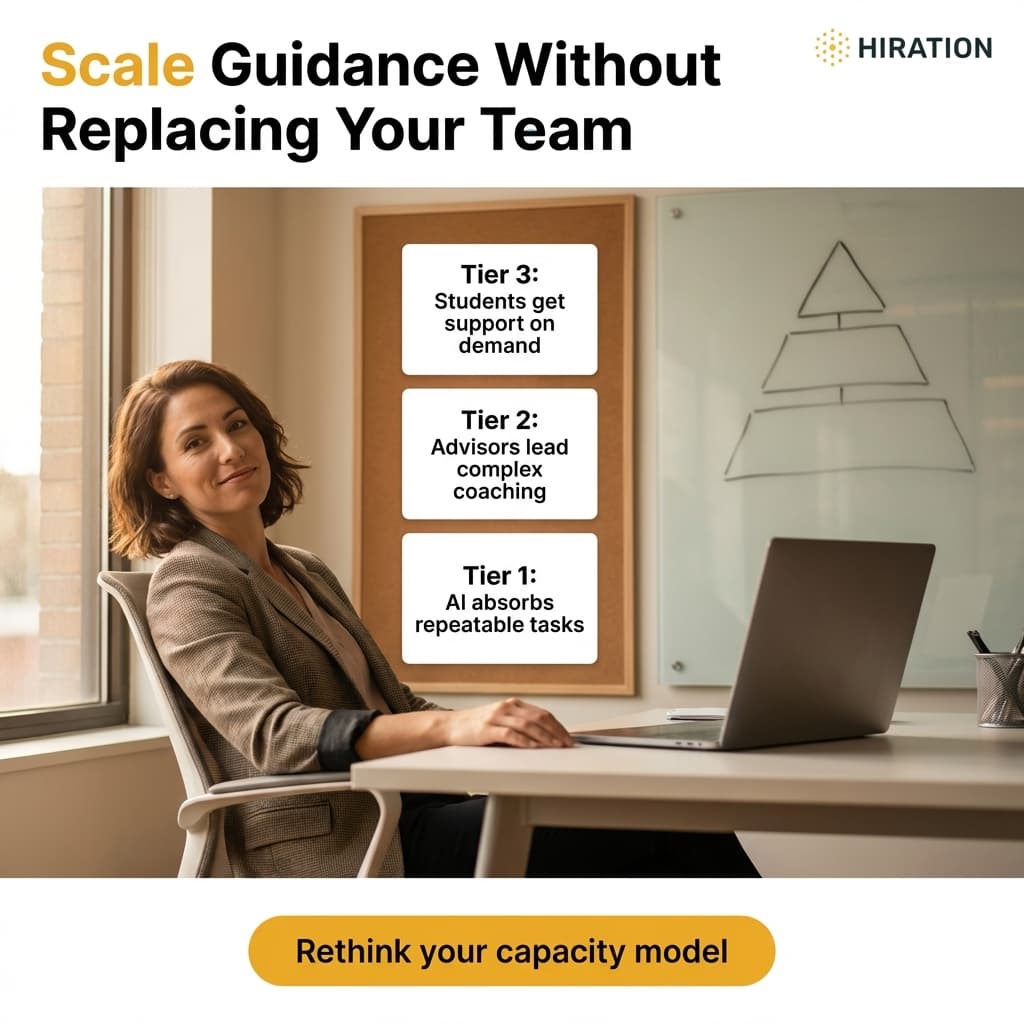
That's Tier 1. AI absorbs the repeatable, high-volume tasks that follow clear rules. Not because the work doesn't matter, but because it doesn't require a human relationship to deliver value.
Tier 2 is where your advisors become exponentially more effective. When they're not spending six appointments a day on resume formatting, they can focus on the conversations that actually require a skilled human. A first-generation student paralyzed by family expectations around career choice. A senior who just got rejected from their dream company and is rethinking everything. A student navigating a disability disclosure in their job search. No AI handles that well. Your advisors do.
Tier 3 is the student experience. Instead of waiting two weeks for an appointment to get resume feedback, students get instant support on demand. Then, when they need deeper guidance, advisors have capacity to see them quickly. Everyone wins.
If your career services team runs social campaigns, Campaign Studio can save you a few hours each week.
See how it worksWhat Most Career Centers Get Wrong About AI
The biggest mistake? Treating AI adoption as an all-or-nothing decision. Directors either resist it entirely ("we're a human-centered office") or try to automate everything at once and overwhelm their staff with new tools.
Start with one task. Pick the single highest-volume, most repetitive request your team handles. At most schools, that's resume review. Deploy an AI tool specifically for that. Train students on how to use it. Track whether appointment volume shifts.
Here's what you'll likely find: students who previously wouldn't have visited your office at all start using the AI tool. Your reach expands before your advisors feel any difference in their schedules. Then, as adoption grows, advisors start noticing their appointments are meatier. More career exploration conversations. Fewer "can you proofread this" sessions.
Another common misstep is positioning AI as a replacement rather than a filter. Your messaging to students matters enormously. "Use this instead of seeing an advisor" kills trust. "Use this to get started, then book an appointment to go deeper" builds a pipeline. Frame it as the first step, not the last one.
A Practical Rollout You Can Start This Week
Pick your highest-volume task. Check your appointment data from the last semester. What are students booking for most often?
Then evaluate one AI tool against that specific use case. Don't shop for a platform that does everything. Find one that does your Tier 1 task well. Tools like VMock, Quinncia, or even a well-configured GPT can handle resume feedback with surprising nuance.
Brief your advising team before you brief students. Advisors who feel blindsided by AI rollouts become your biggest obstacle. Advisors who understand they're getting freed up for more meaningful work become your biggest advocates. Give them a demo. Let them test it. Ask for their input on where the AI falls short so they see themselves as quality control, not as people being replaced.
Finally, set a 90-day checkpoint. How many students used the tool? Did appointment types shift? Are advisors spending more time on Tier 2 conversations?
You don't need a massive budget or an IT department's blessing to start. You need one tool, one task, and the willingness to let your team do what they were actually trained for.
Your Career Services team is already doing this work manually
Campaign Studio turns one idea into a full campaign across Instagram, LinkedIn, email, Handshake, and LMS. Weekly engagement runs on autopilot. Event campaigns build on demand.
Run Your First Campaign