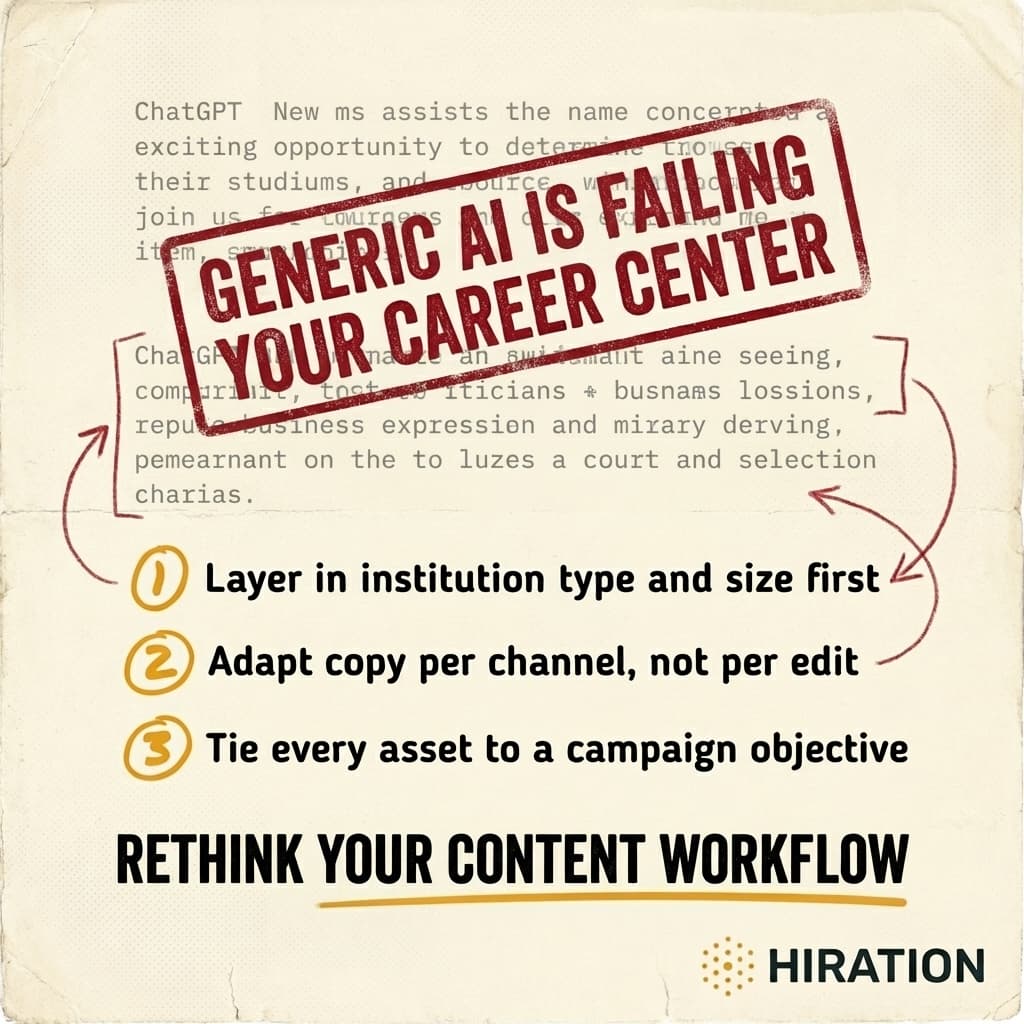
AI Content in Higher Ed: Fix the Context Problem First
Every university using AI to create content is running into the same wall. The outputs sound like they could belong to any institution on earth. That's not a technology failure. It's a context failure.
And it's happening across every department, not just career services. Admissions offices, alumni relations, student affairs, academic programs. Anyone who's opened ChatGPT, typed a prompt, and gotten back something that reads like a higher ed Mad Lib knows exactly what this feels like.
Why Does AI Content Sound the Same for Every University?
Because you're asking a general-purpose tool to do institution-specific work without giving it anything institution-specific to work with.
Consider what happens when someone in your admissions office types: "Write an email inviting prospective students to our open house." ChatGPT doesn't know if you're a 1,200-student liberal arts college in Vermont or a 45,000-student R1 in Texas. It doesn't know your mascot, your signature programs, whether you call it an "open house" or a "preview day," or whether your brand voice is warm and folksy or polished and aspirational.
So it splits the difference. You get the statistical average of every open house email ever written. "Join us for an exciting day on campus where you'll explore everything our university has to offer!" That sentence could appear on literally any institution's website, which is exactly why it's worthless.
The pattern repeats everywhere. Student affairs asks for a mental health awareness post. The alumni office needs a giving day caption. The provost's communications team wants a faculty spotlight. Every output arrives pre-flattened, stripped of the specific texture that makes your institution yours.
If your campus team is exploring AI for content, Campaign Studio can save you a few hours each week.
See how it worksThe Real Problem Is Upstream of the Prompt
Most teams try to fix generic output by writing longer, more detailed prompts. They'll spend five minutes crafting a paragraph of instructions before each request. That helps. A little.
But it doesn't solve the structural issue. Here's why.
Your institution's voice isn't a single prompt. It's a system of decisions. Which words you use and which you avoid. How formal you are on LinkedIn versus Instagram. Whether you lead with outcomes data or student stories. What your president calls the strategic plan. Whether "freshman" is an approved term or a banned one.
No one is going to paste all of that into ChatGPT every time they need a social caption. And even if they did, the person in career services and the person in the business school would paste different versions, creating drift across your brand.
The teams getting good results from AI have moved this context out of individual prompts and into persistent systems. Style guides that are actually referenced (not the 47-page PDF no one opens). Brand vocabulary lists. Channel-specific tone documentation. Approved and blocked phrases.
Whether you feed this context into a custom GPT, a platform with built-in brand constraints, or a shared prompt library, the principle is the same: define your identity once, then apply it everywhere.
A Step-by-Step Approach for Any Higher Ed Team
You don't need a six-month branding project. You need a focused afternoon and some honest answers.
1. Audit what you're actually publishing.
Pull the last 20 social posts, 5 emails, and 3 web pages your team created. Read them out loud. Highlight every sentence that could belong to a different institution without changing a word. That's your generic content. On most teams, it's 40-60% of the total output.
2. Name your voice in three words.
Not aspirational words. Accurate ones. If your career center's Instagram sounds scrappy, direct, and a little funny, say that. If your provost's communications are formal, precise, and evidence-driven, say that. Three words give you a quick filter for every piece of content. Does this draft sound scrappy? No? Revise.
3. Build a short banned-phrases list.
Every institution has crutch phrases that creep into everything. "We're excited to announce" is the most common offender. "Don't miss this opportunity" is a close second. For your school specifically, maybe it's "world-class" or "vibrant community" or "preparing students for success." List 10-15 phrases your team is no longer allowed to use. This single constraint improves AI output dramatically because you're forcing the model away from its most generic tendencies.
4. Create a channel-tone matrix.
A two-column document. Left column lists your channels (Instagram, LinkedIn, email newsletter, website, printed materials). Right column describes the specific tone for each. Instagram might be "casual, visual-first, uses humor, speaks to current students." LinkedIn might be "professional but warm, speaks to employers and alumni, leads with outcomes." This takes 30 minutes and prevents the most common AI content mistake: producing LinkedIn copy that sounds like an Instagram caption, or vice versa.
5. Write five "golden examples" per channel.
Find or create five posts per channel that nail your voice perfectly. These become your reference set. When prompting AI, you can include one as a style example. "Write a post in the style of this example" with a real piece of your best content attached is 10x more effective than abstract instructions like "be engaging and authentic."
What Most Institutions Get Wrong
They treat AI content as a drafting problem when it's actually an identity problem.
A marketing coordinator at a regional state university told me she'd been using ChatGPT for three months before realizing every post she published could have come from the school down the road. Same tone. Same structure. Same vague enthusiasm. She wasn't doing anything wrong with the tool. She just hadn't given it the raw material to do anything distinctive.
Another trap: assuming the communications office owns this. They don't. Or rather, they can't. Not exclusively. When 15 different departments are independently prompting AI tools, the communications team's style guide is irrelevant if no one outside their office uses it. The context needs to live where the content gets created, inside the tools people actually open every day.
And the biggest mistake of all? Treating AI output as final copy. Even with perfect context, AI gives you a strong draft. Your team's job is to add the one specific detail, the unexpected angle, the reference to something happening on your campus right now, that a model could never generate on its own.
One Thing You Can Do This Week
Open a shared document. Title it "[Your Institution] Content Voice." Add three sections: Voice (three descriptor words), Banned Phrases (10-15 entries), and Channel Tones (one paragraph per channel). Fill it out in under an hour. Share it with every person on your team who touches content.
Then take your most-used AI prompt and rewrite it with this context included. Compare the output to what you were getting before. The difference won't be subtle.
Frequently Asked Questions
How do I make AI-generated content sound like my university?
Provide persistent institutional context rather than relying on one-off prompts. Document your brand voice in three descriptor words, create a banned-phrases list of 10-15 overused terms, and include a "golden example" of your best content with each AI prompt. This forces the model away from generic higher ed language toward your specific tone.
Why does ChatGPT produce generic higher education content?
ChatGPT generates the statistical average of all similar content it was trained on. Without specific details about your institution's voice, audience, and terminology, it defaults to the most common higher ed phrasing. The fix isn't a better tool; it's better input that reflects your school's distinct identity.
What is a channel-tone matrix for university communications?
A channel-tone matrix is a simple document that maps each of your communication channels to a specific tone description. For example, Instagram might be "casual, humor-friendly, speaks to current students" while LinkedIn is "professional, outcome-focused, targets employers and alumni." It takes about 30 minutes to create and prevents mismatched content across platforms.
How long does it take to set up a brand voice guide for AI content?
A functional brand voice document can be built in under an hour. Focus on three sections: three voice descriptor words, 10-15 banned phrases, and one paragraph of tone guidance per channel. This isn't a full brand standards manual; it's a practical tool designed to improve AI output immediately.
Most higher ed teams are still stitching AI together by hand
Campaign Studio turns one idea into a full campaign across Instagram, LinkedIn, email, Handshake, and LMS. Weekly engagement runs on autopilot. Event campaigns build on demand.
Run Your First Campaign