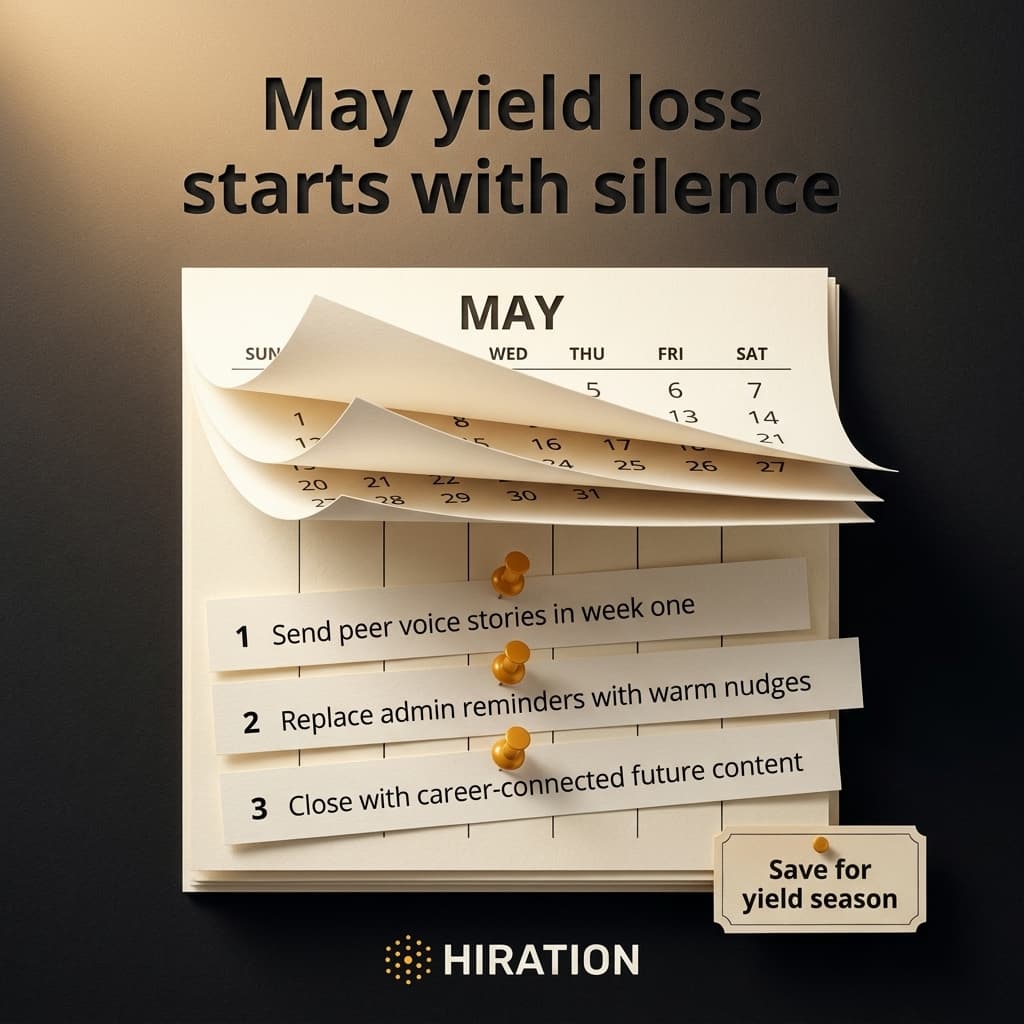
Student Retention Strategies for Small Teams: A Practical Guide
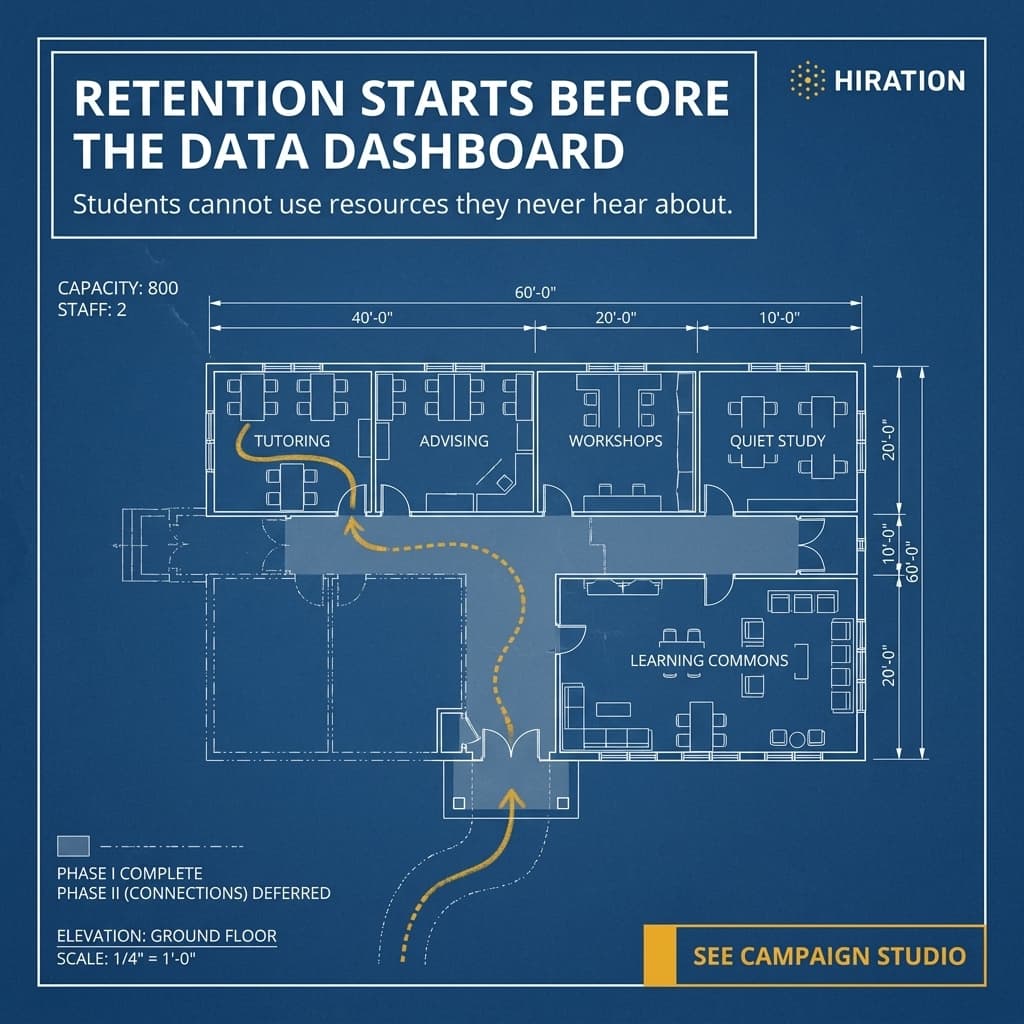
Visual by Campaign Studio · Generate your own for free
Most student retention efforts fail not because the strategy is wrong, but because the right message never reaches the student who needs it. A first-generation sophomore struggling after midterms won't google "academic success center hours." She'll just stop showing up.
That's the gap nobody talks about at retention summits. Everyone's focused on predictive analytics, early alert systems, and dashboard design. Those tools matter. But they assume something dangerous: that once you identify an at-risk student, connecting them to support is the easy part.
It's not.
Retention Is a Visibility Problem, Not Just a Data Problem
Picture this. A two-person student success office manages 800 active caseloads at a regional university. They know exactly which students are flagged. They have tutoring, counseling, food pantry access, and emergency funds available. What they don't have is a way to make students aware those resources exist before crisis hits.
The data dashboard tells them who's at risk. It doesn't tell that student where to go.
We've worked with career centers and student success offices at more than 100 institutions over eight years. The pattern repeats everywhere. The people closest to student outcomes are the furthest from marketing support. Central marketing teams are busy with admissions campaigns, alumni giving, and brand work. Student success gets a Canva login and a suggestion to "post more on social."
So the tutoring center stays invisible. The emergency fund goes underutilized. And the retention committee meets quarterly to discuss why the numbers aren't moving.
If your student success team shares resources online, Campaign Studio can save you a few hours each week.
See how it worksWhy "Just Send an Email" Doesn't Work Anymore
The most common objection to treating retention as a visibility problem goes something like this: "We already communicate with students. We send emails. We put it on the portal."
Let's be honest about what that actually looks like.
A student at a mid-size institution receives an average of 3-5 institutional emails per day. Financial aid deadlines, parking updates, club announcements, dining surveys. By October, most students have trained themselves to ignore anything with an .edu sender. Your carefully written email about free tutoring lands between a homecoming flyer and a phishing warning.
The student portal isn't much better. At one institution we worked with, fewer than 12% of students logged into the student success portal more than once per semester. The resources were there. The students weren't.
This isn't a student engagement failure. It's a distribution failure. And small teams don't have the bandwidth to solve distribution problems with brute force. You can't just send more emails louder.
What Actually Reaches Students (And What Doesn't)
The retention programs seeing real results share a few traits that have nothing to do with budget size.
They meet students on platforms students already use. Instagram Stories, text messages, short-form video. Not because these are trendy, but because the attention is already there. A 15-second video about what happens during a tutoring session removes more friction than a 400-word email ever could.
They time outreach to moments of vulnerability, not administrative convenience. The week before midterms matters more than orientation week. The Monday after fall break, when motivation craters and homesickness spikes for first-year students. A well-timed Instagram post about counseling walk-in hours on that specific Monday reaches students in the moment they need it.
They normalize help-seeking instead of just advertising services. There's a meaningful difference between "Visit the Success Center!" and a peer testimonial that says "I almost dropped out sophomore year and this is what changed." One is a flyer. The other is permission.
They repeat the message more than feels comfortable. Marketing research consistently shows people need 7+ exposures to a message before taking action. Student affairs teams often send one email, post once, and wonder why uptake is low. Repetition across channels isn't annoying. It's necessary.
Can a Two-Person Team Actually Run Retention Campaigns?
This is the real question. And the honest answer is: not without the right tools and not the way marketing departments do it.
A two-person student success office can't produce a 12-week content calendar, shoot original video, write email sequences, manage social accounts, and still do the actual advising work. Asking them to is absurd. But that doesn't mean the campaigns shouldn't happen.
What small teams need are templates built for their specific context. Not generic marketing templates designed for selling products. Content frameworks that understand a student success office talks about academic probation, financial emergencies, and mental health referrals. Pre-built campaigns they can customize in 20 minutes, not 20 hours.
One student success coordinator we work with at a community college in the Midwest described her old process: spending her Sunday afternoons making Canva graphics for the week's Instagram posts, then feeling guilty that the time should have gone to student meetings. She was doing two jobs poorly instead of one job well.
After switching to campaign templates designed for student success messaging, she cut her content creation time to about two hours per week. More importantly, her center saw a 34% increase in walk-in appointments during midterm weeks compared to the previous year. Same staff. Same budget. Different visibility.
The Counter-Argument (And Why It Falls Apart)
Skeptics will say retention is fundamentally about relationships, not marketing. And they're right. Partially.
The advisor who notices a student hasn't attended class. The faculty member who writes a personal check-in email. The RA who walks a resident to the counseling center. These human moments are irreplaceable. No Instagram campaign substitutes for a person who cares.
But here's what that argument misses. Relationships require a first contact. A student has to walk through the door before an advisor can build rapport. A student has to know counseling exists before an RA can recommend it. Visibility creates the conditions for relationships to happen.
At institutions with strong retention numbers, you'll almost always find both: genuine human connection and consistent, well-distributed messaging about where to find help. One without the other leaves gaps. Relationships without visibility means you only help students who already know to ask. Visibility without relationships means students show up once and don't come back.
Small teams need both. They just need the visibility piece to not eat their entire week.
One Thing to Do This Week
Pull up your institution's midterm calendar. Identify the exact week students receive midterm grades. Now build one campaign for that week. Three Instagram posts, two emails, one text message. All saying the same thing in different ways: here's where to get help, here's what it actually looks like, here's a student who used it.
That single week of coordinated outreach will reach more at-risk students than a semester of sporadic posting. You don't need a marketing team. You need a plan, a template, and the willingness to say the same thing seven times without flinching.
Frequently Asked Questions
How can a small student success team improve retention without a big budget?
Focus on timing and channel selection rather than volume. Build short, targeted campaigns around high-vulnerability moments like midterm grade release and post-break Mondays. Use pre-built templates designed for student success messaging to cut content creation time from hours to minutes.
What is the best way to promote student support services on campus?
Meet students on platforms they already use, primarily Instagram, text messaging, and short-form video. Normalize help-seeking through peer testimonials rather than generic flyers, and repeat your message across multiple channels at least seven times. Timing outreach to moments of stress outperforms blanket awareness campaigns.
Why don't students use campus resources even when they're available?
Most students don't ignore resources deliberately. They either never hear about them amid the flood of institutional emails, or they don't understand what using the resource actually looks like. Removing that uncertainty through brief videos or peer stories significantly increases walk-in rates.
How many times should you communicate a student resource before students take action?
Marketing research suggests people need at least 7 exposures to a message before acting on it. For student success teams, this means sharing the same resource across email, social media, text, and in-person channels multiple times during a targeted window, rather than posting once and hoping for the best.
Your Student Success team is already doing this work manually
Campaign Studio turns one idea into a full campaign across Instagram, LinkedIn, email, Handshake, and LMS. Weekly engagement runs on autopilot. Event campaigns build on demand.
Run Your First Campaign