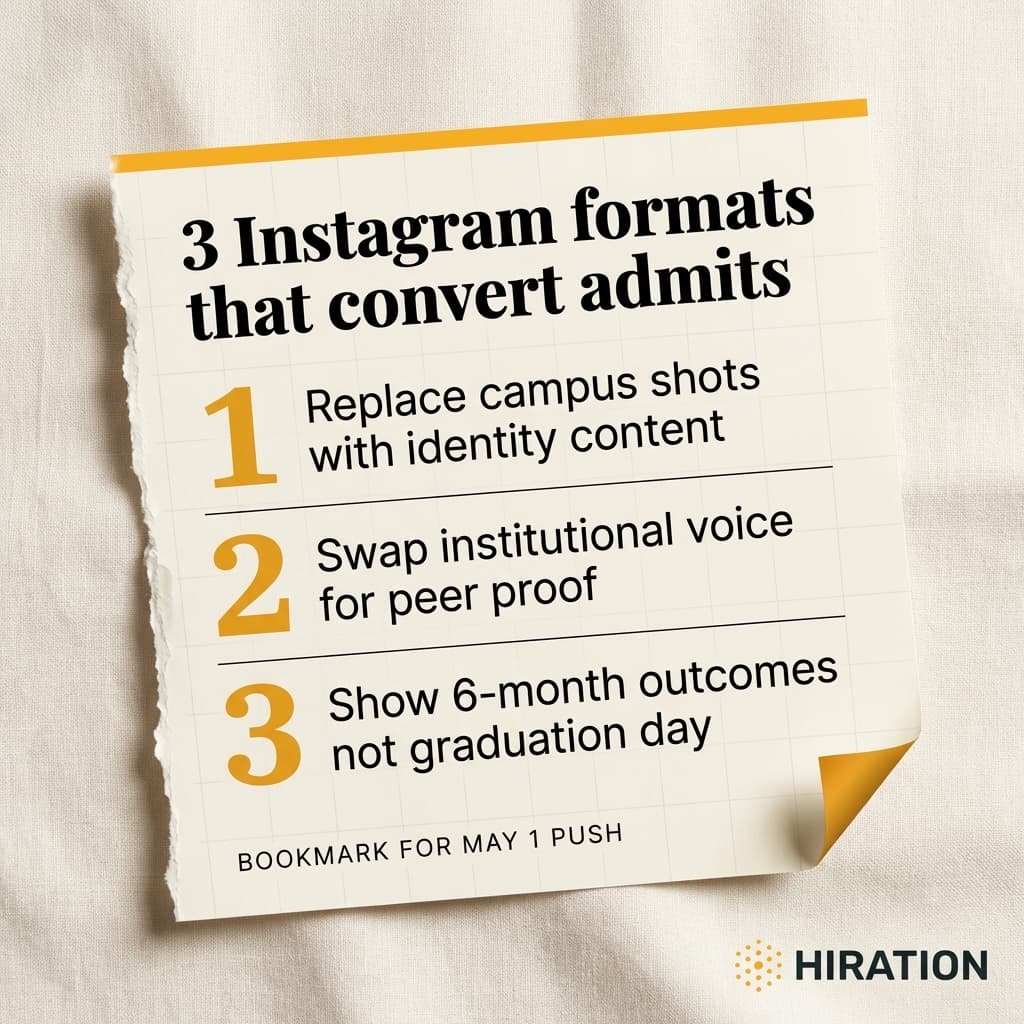
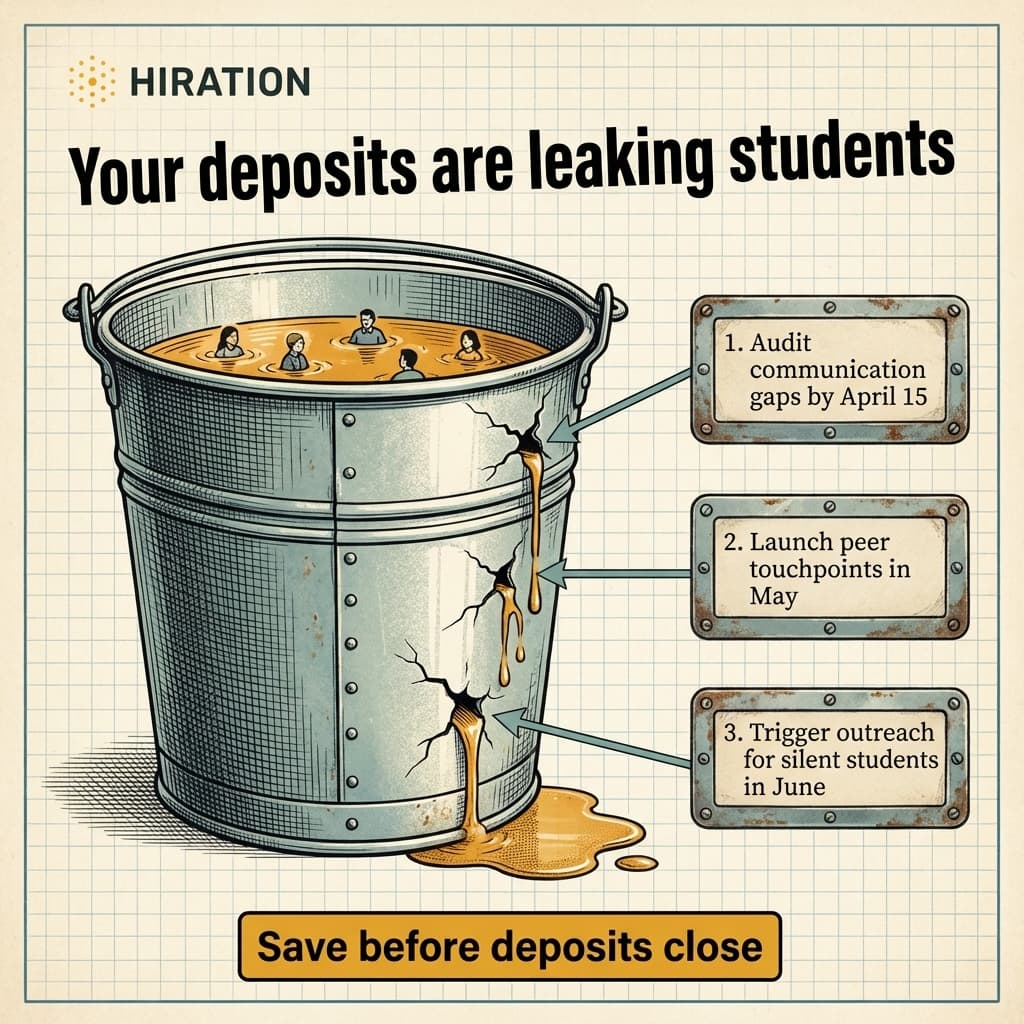
May Deposited Student Content: Week-by-Week Guide to Prevent Summer Melt
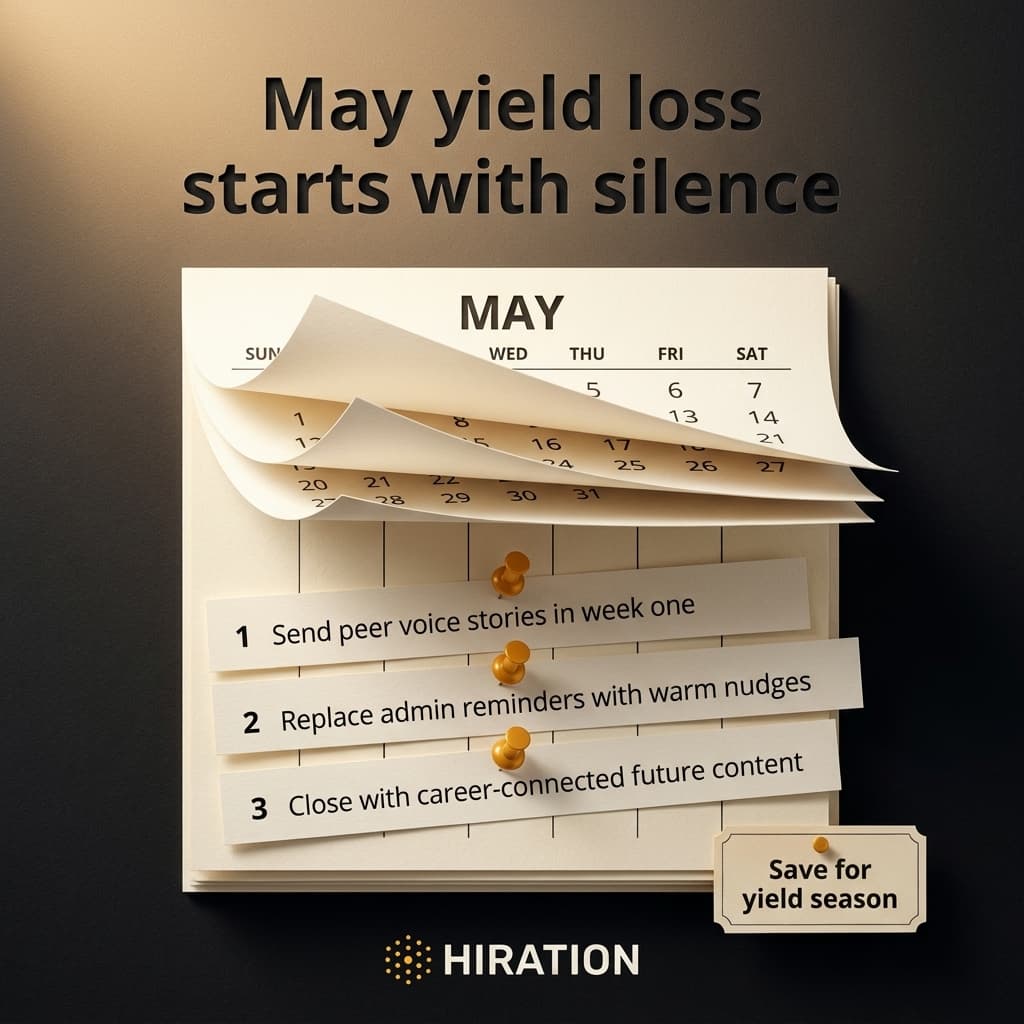
Visual by Campaign Studio · Generate your own for free
Most enrollment teams go quiet in May. That silence costs them 10-20% of their deposited class.
Summer melt doesn't start in June or July. It starts the week after a student puts down their deposit, when the excitement fades and the anxiety creeps in. Did I pick the right school? Will I make friends? Can my family actually afford this? These questions don't arrive on a schedule, but they do follow a pattern. And if your content strategy for May is "send the housing reminder and wait for orientation," you're leaving yield on the table.
Here's a week-by-week approach to what deposited students actually need to hear in May, and who they need to hear it from.
Why Do Deposited Students Ghost in May?
Because nobody's talking to them. Or worse, the only messages they're getting are transactional. Submit your immunization records. Complete your FAFSA verification. Set up your student email.
These emails are necessary. They're also emotionally empty. A student who just made one of the biggest financial decisions of their life is getting the same energy as a utility company asking them to set up autopay.
Meanwhile, other schools haven't stopped recruiting. Competitors are still sending personalized outreach, still running admitted student events, still showing up in Instagram ads. Your deposited students are seeing all of it. And the ones who felt uncertain to begin with? They're quietly reopening their options.
The institutions that protect their yield in May treat this month like a four-week campaign, not an administrative wind-down. Every message has a job. Every week addresses a different emotional need.
If your admissions team creates recruitment content, Campaign Studio can save you a few hours each week.
See how it worksWeek One (May 1-7): Lead With Peer Voices, Not Institutional Ones
The first week after deposit deadlines should feel like a welcome, not a to-do list. Students need social proof that they made the right call.
This is where peer voice content does the heaviest lifting. Short video clips from current students. Instagram stories from orientation leaders. A text message from a student ambassador that says, "Hey, I was nervous too. Here's what surprised me about my first semester."
Specific formats that work well in week one:
- 60-second "why I chose [school]" videos from current sophomores and juniors. Not polished productions. Phone recordings with real answers.
- A group chat or Discord invite where deposited students can find their people. Roommate matching threads, major-specific channels, that kind of thing.
- A carousel post or email featuring 5-6 student faces with one-sentence quotes about their favorite unexpected moment on campus.
The goal isn't information delivery. It's emotional reinforcement. You want a deposited student scrolling their phone at 11 p.m. to see someone who looks like them, sounds like them, and is glad they're there.
One enrollment team I've seen do this well sends a single text on May 2nd. Just a photo of a current student holding a whiteboard that says "You're gonna love it here" with the student's name and major. No links. No calls to action. Open rates were over 80%.
Week Two (May 8-14): Replace Admin Reminders With Warm Nudges
Yes, students still need to complete their housing applications and health forms. But how you frame those tasks matters enormously.
Compare these two subject lines:
- "Action Required: Housing Application Due May 15"
- "Pick your room before your future roommate does 👀"
Same task. Completely different emotional register. The second one creates anticipation instead of obligation.
Week two is when you bundle the necessary administrative steps into content that feels human. A few approaches that consistently perform:
- Send a "your May checklist" email that mixes logistical tasks with fun ones. "Submit your housing deposit" sits next to "Follow your class Instagram" and "Tell us your move-in day playlist song." Suddenly the checklist doesn't feel like paperwork.
- Have a current student record a 90-second walkthrough of the tasks, talking through each one casually. "This one took me like four minutes, don't stress."
- Use SMS for the truly urgent deadlines. Email for everything else. Students under 22 treat their inbox like a junk drawer, but they read every text.
The mistake most teams make here is front-loading all administrative communication into a single overwhelming email sent the day after deposit. Spread it out. One task per touchpoint. Give each message room to breathe.
Week Three (May 15-21): Build the Bridge to Their Future
By mid-May, the logistical anxiety has usually settled. What replaces it is a deeper, existential kind of doubt. Will this degree actually lead somewhere? Is this investment going to pay off?
This is where career-connected content becomes your best yield protection tool. And most enrollment offices completely ignore it because they think career services is someone else's department.
Stop thinking in org charts. Start thinking in student anxieties.
Week three content should connect the dots between enrollment and employment. Show deposited students what their life could look like two, five, ten years after graduation.
- Feature a recent alum (graduated in the last 3-5 years) in their current job, with a quick story about how they got there. Keep it specific. "Jess graduated in 2022 with a communications degree and now runs social media for the Portland Trail Blazers" hits harder than "our graduates work at top companies."
- Share internship placement data for their specific major, if you have it. "87% of our nursing students secure clinical placements before junior year" answers a question they haven't asked yet but are definitely thinking about.
- A short email from a career services staff member introducing themselves. Not a sales pitch. Just: "I'm here, this is what I help with, and you can book time with me starting your first semester."
Parents are reading these emails too. Career outcome content does double duty because it reassures the people writing the tuition checks.
Week Four (May 22-31): Create Momentum Toward Orientation
The last week of May should point forward. Orientation is coming. Move-in is real. This is actually happening.
Content in week four should build anticipation and reduce the unknowns that make students anxious about showing up.
- Send a "what to expect at orientation" guide that's genuinely useful. Not a PDF buried three clicks deep on your website. A mobile-friendly page or a series of short videos covering what to wear, what to bring, and what the first hour looks like.
- Introduce orientation leaders by name and face. Let students feel like they already know someone before they arrive.
- Run a countdown. It sounds simple, but a daily Instagram story counting down to orientation creates a sense of shared momentum. Other deposited students see it, react to it, comment on it. Community forms in the comments.
One thing to avoid in week four: don't introduce new administrative tasks. If a student has outstanding items, send a gentle individual reminder. But the broadcast messaging should be all forward energy. Excitement, not obligation.
What Does This Look Like in Practice?
You don't need a 10-person marketing team to run this. A single enrollment counselor with a content calendar, a smartphone, and access to a few willing current students can execute most of this in 3-4 hours per week.
The key shift is intentionality. Instead of sending messages when tasks are due, you're sending messages when students need them emotionally. That reframe changes everything about your May communication.
Map it out this week. Open a blank calendar for May. Assign each week its theme: peer voices, warm nudges, career futures, orientation momentum. Then fill in the specific touchpoints. One email, one text, one social post per week minimum. More if you have the capacity, but consistency beats volume.
The schools that hold their class through summer aren't louder. They're just present at the moments that matter.
Frequently Asked Questions
What is summer melt in college enrollment?
Summer melt is when students who've deposited at a college quietly withdraw or fail to enroll before fall classes begin. It typically affects 10-20% of deposited students, with higher rates at public universities and institutions serving first-generation populations. Most melt happens between May and August due to financial concerns, lack of connection, or competing offers.
How often should you contact deposited students before orientation?
Aim for at least one meaningful touchpoint per week from deposit through orientation. Mix channels: one email, one text, and one social media post weekly gives students three chances to engage without feeling overwhelmed. Avoid clustering all communication around administrative deadlines, which creates silence between task-driven bursts.
What type of content keeps deposited students engaged?
Peer-to-peer content consistently outperforms institutional messaging. Short student videos, ambassador text messages, and social media takeovers from current students generate the highest engagement. Career outcome stories and alumni spotlights also perform well, especially with parents who influence the final enrollment decision.
How can a small enrollment team prevent summer melt?
Focus on a four-week content calendar with one theme per week: peer voices, warm administrative nudges, career-connected stories, and orientation momentum. A single staff member with a smartphone and 3-4 willing current students can produce enough content. Consistency matters more than production quality or volume.
Your Admissions team is already doing this work manually
Campaign Studio turns one idea into a full campaign across Instagram, LinkedIn, email, Handshake, and LMS. Weekly engagement runs on autopilot. Event campaigns build on demand.
Run Your First Campaign