Instagram Content That Converts Admitted Students: 3 Formats That Work
Visual by Campaign Studio · Generate your own for free
Between April 1 and May 1, your admitted students aren't scrolling Instagram for pretty campus photos. They're looking for answers to three deeply personal questions: Did I pick the right school? Will I find my people? Am I about to waste my family's money?
Most admissions teams miss all three. And then they wonder why yield rates keep slipping.
Campus Beauty Shots Don't Drive Deposit Decisions
Here's what a typical admissions Instagram looks like in April: drone footage of the quad at golden hour, a carousel of smiling students at some event from last semester, a graphic with the deposit deadline in brand fonts. It's polished. It's safe. And it does almost nothing for the admitted student lying awake at 11pm wondering if they should have picked the other school.
The problem isn't production quality. It's psychological misalignment. Those campus shots reassure donors and current parents. They make the president's office happy. But admitted students aren't donors. They're 17- and 18-year-olds in the middle of one of the first high-stakes decisions of their lives. They need content that speaks to their specific anxieties, not content that could run in an alumni magazine.
Think about what's actually happening in their heads. They've been accepted to multiple schools. They've told friends and family about their top choice. Now doubt is creeping in. Every school they got into is sending them glossy content that looks identical. Your job isn't to look pretty. Your job is to make them feel certain.
If your admissions team creates recruitment content, Campaign Studio can save you a few hours each week.
See how it worksWhat Are Admitted Students Actually Looking For on Instagram?
The three questions driving deposit decisions map to three distinct emotional needs. Understanding them changes everything about your content strategy.
"Did I pick the right school?" is an identity question. Students want confirmation that this campus is where people like them belong. Not "diverse and inclusive" in the abstract. Specifically: are there students who share my interests, my background, my weird obsession with competitive debate or K-pop or pre-med anxiety?
"Will I find my people?" is a belonging question. This one keeps introverts up at night especially. They're not worried about the institution. They're worried about the first week. The dining hall. The roommate. They want proof that real friendships form here, not staged group photos with everyone wearing matching orientation t-shirts.
"Am I about to waste my family's money?" is a future-self question. This hits hardest at schools where families are stretching financially. Students want to see what they'll become. Not in four years. In six months. What does a sophomore look like who chose this school as a freshman?
Once you see these three questions, you can't unsee them. They become your entire content framework through May 1.
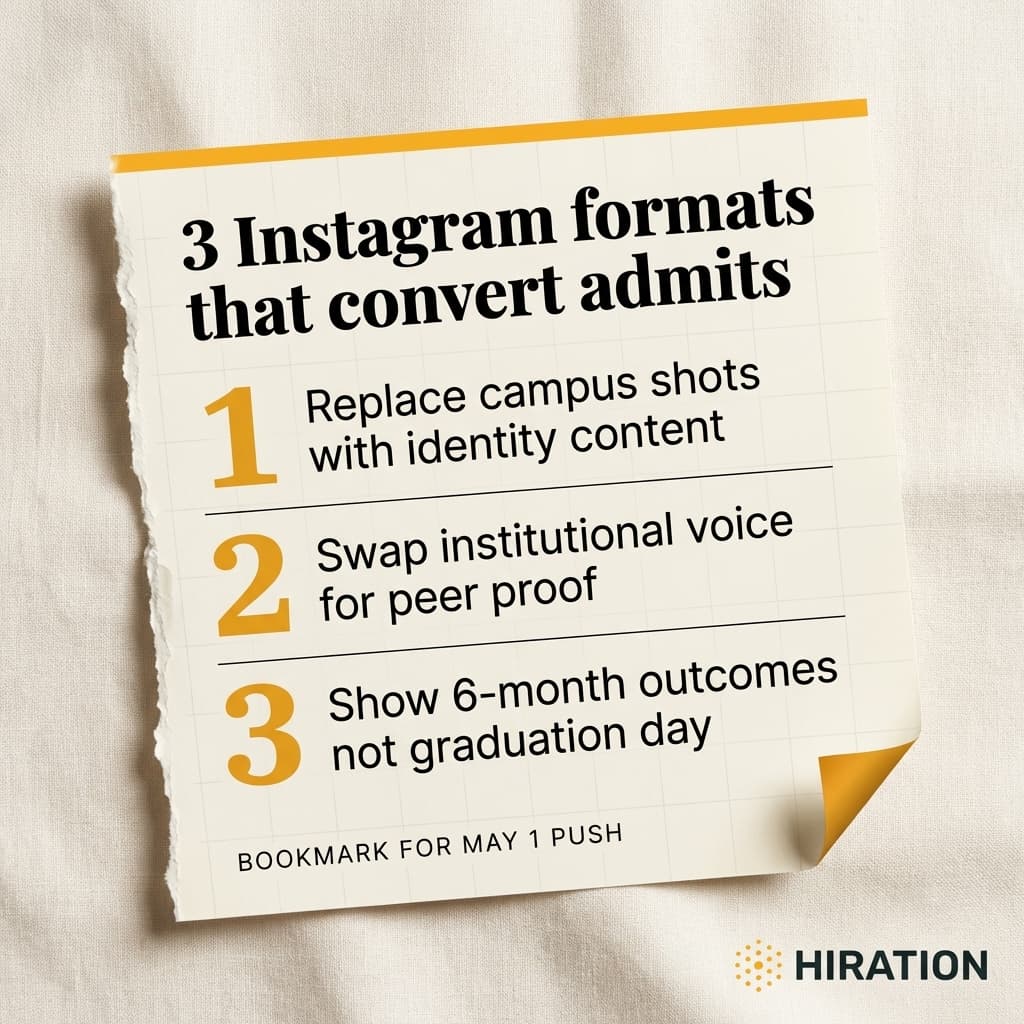
The Three Content Formats That Actually Convert
Forget your content calendar for a second. Between now and deposit day, every single post should map to one of these three formats.
Format 1: Identity-Confirmation Content
This is content that makes a specific type of student think, "Oh, there are people like me here." The key word is specific. A Reel featuring a first-gen computer science student talking about her favorite professor lands differently than a generic "student spotlight."
Practical examples that work:
- A day-in-the-life Reel from a student in a niche major, with real details (the 8am lab, the specific coffee shop, the club meeting at 7pm)
- A carousel titled "5 things I wish I knew before starting as a [major] student here"
- A student talking to camera about the moment they knew this school was right, with enough specificity that it feels unrehearsed
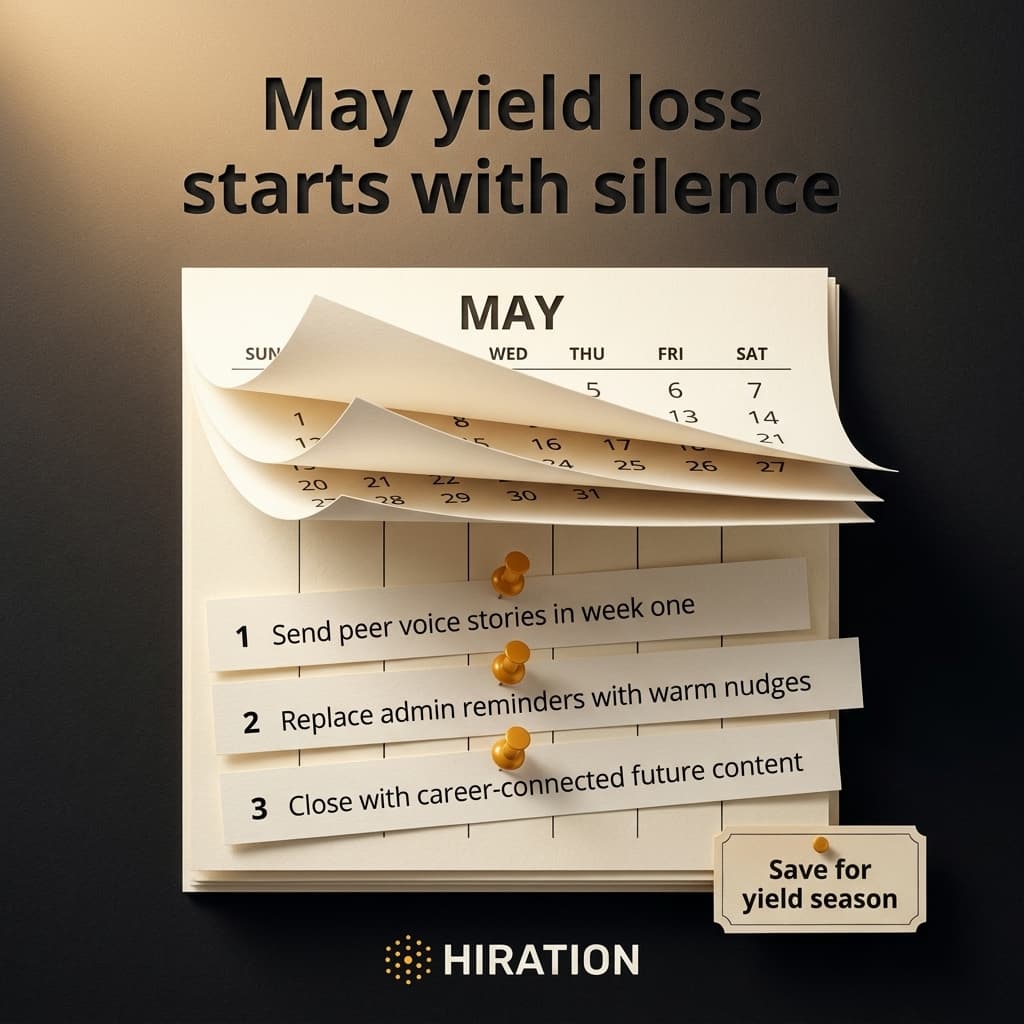
The trick is volume and variety. One identity post helps one type of student. You need to cover the range. The pre-med student. The first-gen student. The transfer student. The kid from a rural town who's never lived in a city. Post three to four of these per week in April.
Format 2: Peer-Proof Content
Peer proof is different from identity confirmation. Identity content says "people like you are here." Peer proof says "and they actually like it." This format leans heavily on current students speaking in their own voice, without scripts, without polish.
What works here is the absence of institutional voice. The admissions office shouldn't sound like the admissions office. Let a sophomore answer "What surprised you most about your first semester?" on camera with zero prep. The stumbles and "umms" are features, not bugs. They signal authenticity in a feed full of manufactured content from every other school.
One format that's wildly underused: DM-style Q&A in Stories. Have a current student take over your Stories and answer real questions from admitted students in real time. Screenshot and save the best exchanges as a highlight. Admitted students trust other students roughly a thousand times more than they trust you. So get out of the way.
Format 3: Future-Self Content
This is the format most admissions teams get wrong because they default to graduation photos and career placement stats. Nobody making a deposit decision is thinking about graduation day. That's too abstract, too far away.
Future-self content should show the six-month version. What does a student look like one semester in? Show the sophomore who landed a research position. The junior who started a campus organization as a freshman. The student who came in undeclared and found their major by October.
The timeframe matters enormously. "I graduated and got a job at Google" is aspirational but disconnected. "By my second semester, I was already doing undergraduate research in a lab I love" is close enough to feel real. Attainable beats impressive every time.
A strong format: a before-and-after Reel. Show a student's move-in-day photo next to a clip of them now, eight months later, doing something specific on campus. Let them narrate the gap. "When I moved in, I didn't know anyone and I was terrified. Now I run the environmental advocacy club and my roommate is my best friend." That's the content that gets a deposit.
How Do You Build This Content Quickly With a Small Team?
You don't need a video production team. You need five current students with phones and a shared Google Doc of prompts.
Here's a realistic weekly workflow for a two-person admissions social team:
- Monday: Send five students a prompt via text. Something like "Record a 30-second video answering: What's one thing about [school] that surprised you?" No scripts. No expectations of quality.
- Tuesday-Wednesday: Collect the videos. Do minimal editing. Add captions (non-negotiable for accessibility and silent scrolling). Batch-schedule three Reels.
- Thursday: Run a Stories takeover with a current student answering admitted student questions.
- Friday: Post one future-self carousel using a student's own photos and a short written narrative.
That's five to six pieces of content per week, all mapped to the three-question framework, produced without a single drone shot or graphic designer.
Stop Posting for the Wrong Audience
The biggest mistake admissions teams make in April isn't bad content. It's content aimed at the wrong people. Your Instagram during yield season has one audience: the admitted student who hasn't deposited yet. Not prospective students. Not alumni. Not the board of trustees.
Every post between now and May 1 should pass a simple test. Ask yourself: does this answer one of the three questions? If it doesn't, save it for June.
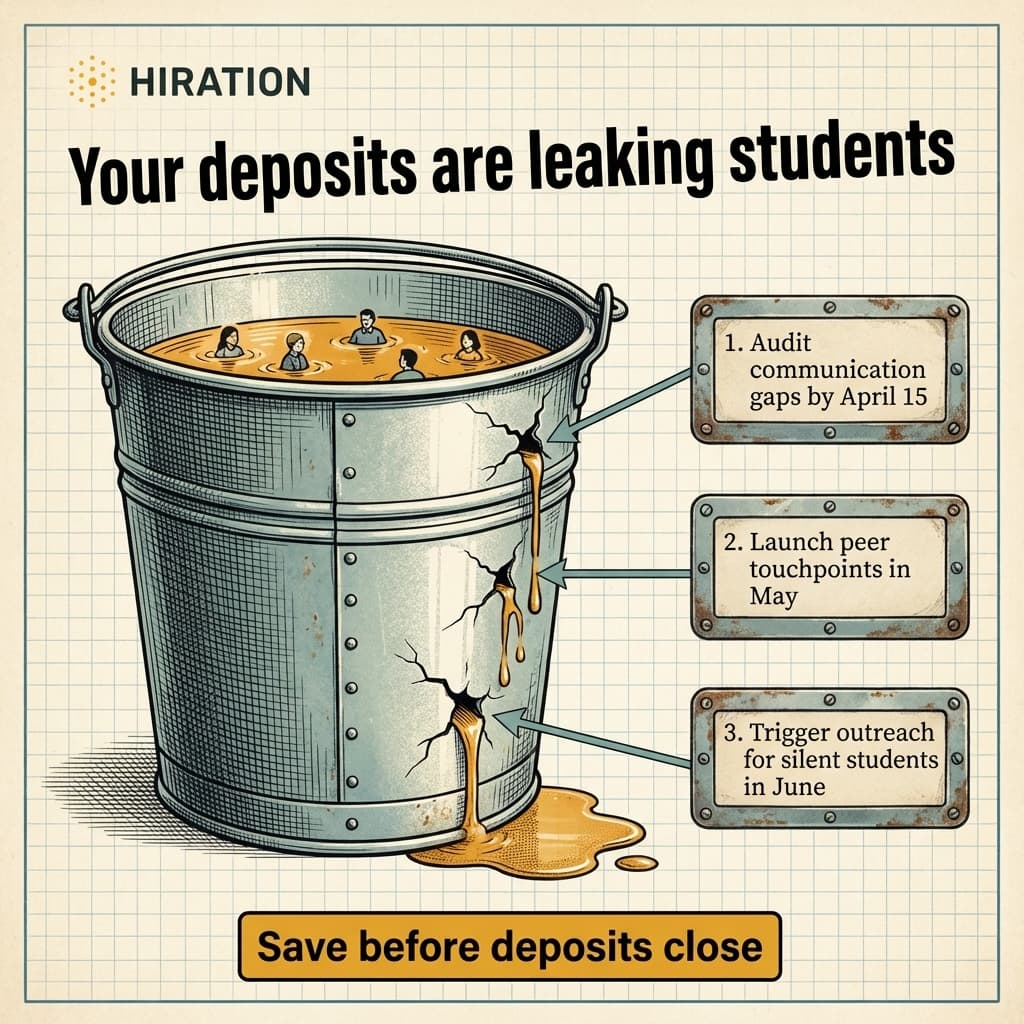
One thing you can do this week: audit your last 10 Instagram posts. Count how many would actually help an anxious admitted student feel more certain about depositing. If the number is below five, you know exactly what needs to change.
Frequently Asked Questions
What type of Instagram content helps convert admitted students?
Three formats drive deposits: identity-confirmation content (showing students like them on campus), peer-proof content (current students speaking authentically about their experience), and future-self content (showing what students look like six months in, not at graduation). All three address the specific anxieties admitted students feel before committing.
How often should admissions teams post on Instagram during yield season?
Aim for five to six posts per week between April 1 and May 1, mixing Reels, carousels, and Stories takeovers. Volume matters because each piece of identity-confirmation content only resonates with a specific subset of admitted students. You need variety to reach different student profiles.
Why don't campus beauty shots work for admitted student yield?
Campus beauty shots reassure donors and alumni but don't address the emotional questions driving deposit decisions. Admitted students want to know if people like them belong at your school, whether they'll find friends, and if the investment is worth it. Drone footage of the quad answers none of those questions.
How can a small admissions team create enough Instagram content for yield season?
Recruit five current students and send them weekly video prompts via text. Have them record 30-second selfie videos with no scripts. Pair that with one Stories takeover per week and a Friday carousel featuring a student narrative. A two-person team can produce five to six posts weekly with this approach and zero production budget.
Your Admissions team is already doing this work manually
Campaign Studio turns one idea into a full campaign across Instagram, LinkedIn, email, Handshake, and LMS. Weekly engagement runs on autopilot. Event campaigns build on demand.
Run Your First Campaign