Why Higher Ed Teams Get Less From AI Than They Should
Key Takeaways
- Higher ed teams adopt AI tools individually but never build workflows, so productivity gains evaporate between steps.
- The real bottleneck isn't content creation. It's the 47 minutes of copy-paste and reformatting between platforms.
- Point solutions don't compound. Only connected workflows turn AI speed into actual time saved for small teams.
The career services director running a 3,000-student portfolio with two staff members and zero marketing support is not underperforming. They are doing something remarkable with almost nothing, and the fact that AI hasn't meaningfully changed their workload yet is a systems problem, not a people problem.
If your campus team is exploring AI for content, Campaign Studio can save you a few hours each week.
See how it worksThe Cobbled Stack Is Costing You Hours You Don't Notice
Here's what a typical campaign looks like at a 3-person career services office. It's Tuesday morning. The spring career fair is Friday. The marketing team is slammed with admissions priorities, so you're on your own.
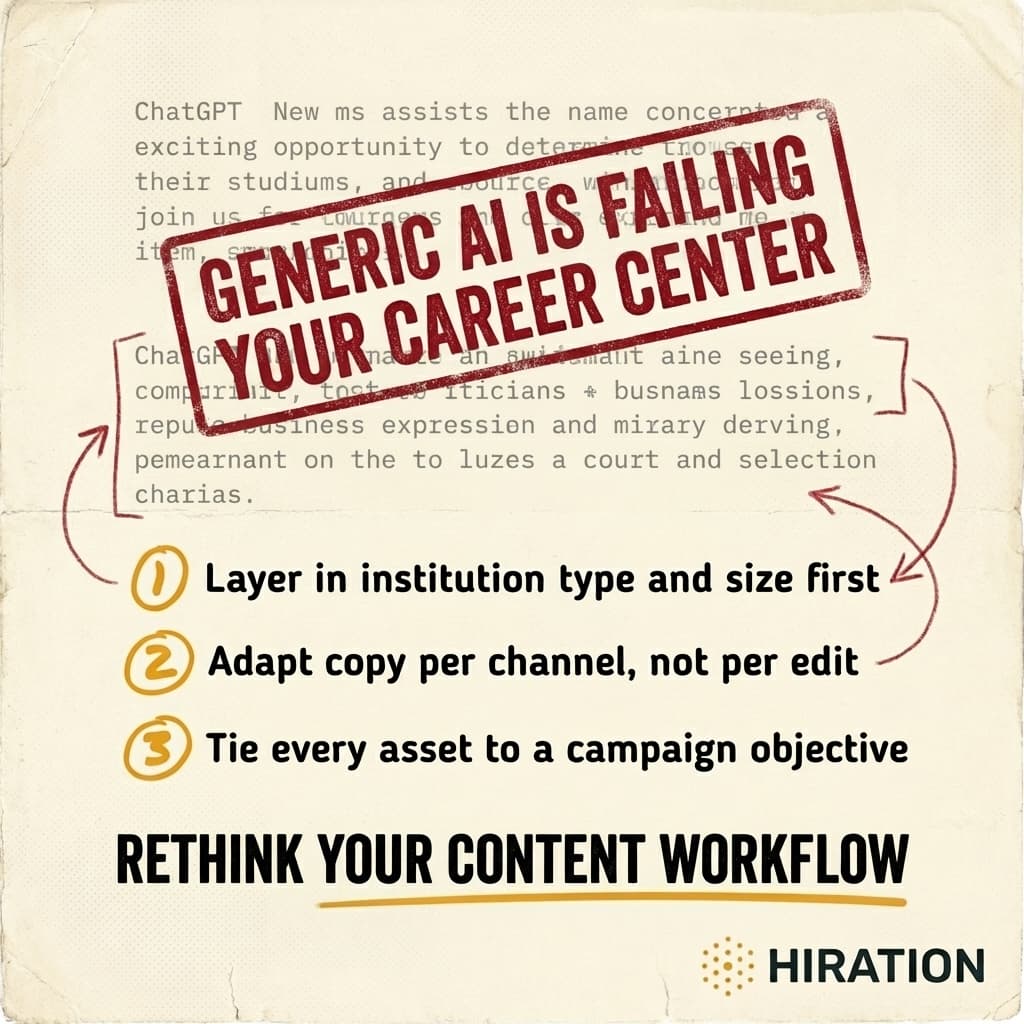
You open ChatGPT and prompt it for Instagram caption ideas. You get five options, pick one, edit it. Then you open Canva, find a template that sort of matches your university's brand guidelines, swap in the details, export it. You draft an email in your ESP, realize you need a different version for first-years versus seniors, duplicate and edit. You log into Handshake to create the event listing. You post to LinkedIn manually. You update the LMS announcement.
Three hours later, you've produced one campaign across maybe four channels. And most of those hours weren't spent writing or designing. They were spent switching tabs, reformatting text, resizing images, and remembering passwords.
This is the cobbled stack. Canva plus ChatGPT plus email threads plus manual posting. Every tool in isolation works fine. Together, they create a workflow that's 70% logistics and 30% creative work. AI made the 30% faster. Nobody touched the 70%.
According to EDUCAUSE's 2024 survey, 88% of higher ed institutions reported using AI in some capacity, but fewer than 20% described their AI adoption as "strategic" or "integrated." That gap tells the whole story. Adoption is high. Integration is almost nonexistent.
Why Point Solutions Don't Compound
The image processing speed of Canva doesn't help you when you're manually copying that caption into three different platforms. ChatGPT's ability to draft an email in 30 seconds doesn't matter when you spend 12 minutes reformatting it for your email tool's editor. Each tool saves time inside its own walls. But small teams don't live inside one tool. They live in the gaps between them.
Think of it like this.
| Approach | Time Creating Content | Time on Logistics (reformatting, resizing, cross-posting) | Total Time Per Campaign |
|---|---|---|---|
| No AI tools | 90 min | 60 min | ~2.5 hours |
| Cobbled stack (Canva + ChatGPT + manual posting) | 35 min | 55 min | ~1.5 hours |
| Connected workflow (single input, multi-channel output) | 10 min | 5 min | ~15 min |
The cobbled stack cuts content creation time in half. Good. But it barely touches logistics time because you're still the middleware. You're the integration layer between tools that don't talk to each other. A connected workflow collapses both.
We've watched this pattern across more than 100 institutions. The teams that report AI "not really helping" aren't using bad tools. They're using good tools badly connected. Or rather, not connected at all.
Is the Problem AI Adoption or AI Architecture?
Someone will push back here. "Our team uses AI every day. We're not behind."
I don't doubt it. Most career services professionals I talk to are experimenting. They're writing prompts, generating drafts, trying image generators. Individual adoption isn't the issue.
The issue is architecture. How does the output of one AI tool become the input of the next step? In almost every higher ed office I've seen, the answer is: a human copies and pastes it. That human is usually the same person who's also advising students, coordinating employer relations, and managing event logistics.
A 2-person team serving 3,000 students with 3-8 events a month cannot also be the glue layer between six disconnected software products. And yet that's exactly what we ask them to be.
The counter-argument I hear from IT leaders is that integration platforms exist. Zapier, Make, Power Automate. True. But these require technical setup, ongoing maintenance, and someone who understands both the tools and the workflows deeply enough to connect them correctly. At a large R1 with dedicated IT support for student affairs, maybe. At a regional university where career services shares an IT ticket queue with facilities management? That integration project is never getting prioritized.
What Actually Works for Teams of Two
After eight years of building tools for these teams, I've noticed a pattern that separates the offices producing consistent, polished campaigns from those stuck in reactive mode. It's not budget. It's not headcount. It's whether their workflow requires one decision or twenty.
The high-output teams have found ways (with varying tools) to make a single creative decision, like "promote the spring career fair to juniors and seniors," and have that decision cascade into finished assets across channels. One input, multiple outputs. The low-output teams make that same decision and then execute it separately on every platform.
This is why we built Hiration Campus as a campaign studio rather than another content generator. Generating an Instagram caption is a solved problem. Generating an Instagram post, a LinkedIn update, a Handshake event description, an email sequence, and an LMS announcement from one brief, all formatted correctly for each channel, in under 15 minutes? That's the problem nobody was solving.
But the principle holds regardless of what tool you use. When you evaluate any AI product for your office, ask one question: does this reduce the number of decisions between idea and published campaign? If it only speeds up one step while leaving you to manage the rest, it's a point solution. Point solutions don't compound.
How Do You Audit Your Current AI Workflow in 30 Minutes?
This week, try this. Pick your most recent campaign, any event promotion, workshop announcement, or student outreach. Write down every step from the moment someone said "we should promote this" to the moment it was live on all channels. List every tool you opened, every file you exported and re-uploaded, every piece of text you copied from one place to another.
Then count the steps. Most teams land somewhere between 15 and 30. Circle the ones where you were actually making a creative or strategic decision versus just moving content between systems.
I'd bet fewer than a third of those steps involve real thinking. The rest is logistics. That's your AI gap. Not in the tools you're using, but in the space between them.
Your team isn't underperforming. The architecture around them is. Fix the architecture, and two people can outproduce a team of five working the old way. I've seen it happen at institutions from community colleges to Ivy-adjacent programs. The constraint was never talent. It was always the workflow.
Frequently Asked Questions
How can a small career services team use AI effectively?
Focus on workflow integration, not individual tool adoption. The biggest time savings come from reducing the copy-paste logistics between platforms, not from faster content generation in any single tool. Look for solutions that take one campaign brief and produce assets across multiple channels simultaneously.
What is the biggest mistake higher ed teams make with AI tools?
Adopting multiple point solutions that don't connect to each other. Teams end up spending more time moving content between Canva, ChatGPT, email platforms, and social channels than they spend on actual creative work. The human becomes the integration layer, which defeats the purpose of AI speed.
How long should it take to create a multi-channel student engagement campaign?
With a connected workflow, about 15 minutes from brief to publishable assets across Instagram, LinkedIn, email, and your LMS. Most teams currently spend 1.5-3 hours because they're reformatting and re-uploading the same content across disconnected tools.
Why doesn't ChatGPT alone solve higher ed marketing challenges?
ChatGPT speeds up drafting but doesn't handle formatting for specific platforms, image creation, cross-channel distribution, or brand consistency. A career services team still needs to manually adapt, resize, and publish each piece of content. The drafting was never the real bottleneck.
Most higher ed teams are still stitching AI together by hand
Campaign Studio turns one idea into a full campaign across Instagram, LinkedIn, email, Handshake, and LMS. Weekly engagement runs on autopilot. Event campaigns build on demand.
Run Your First Campaign