Alumni Engagement Strategies for Small Advancement Teams
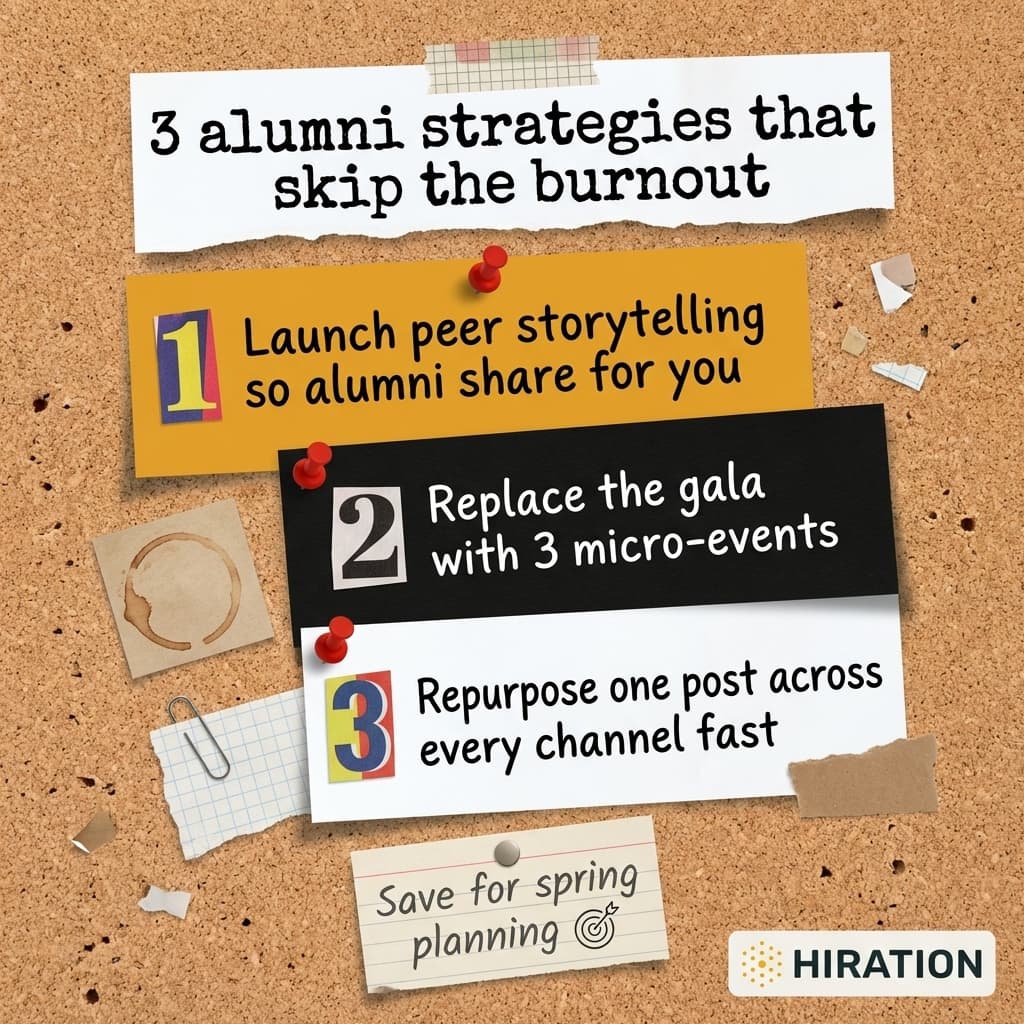
Visual by Campaign Studio · Generate your own for free
Most advancement offices with one to three people don't have a strategy problem. They have a capacity problem. The ideas are there. The whiteboard is full. But when the same person writing the alumni newsletter is also coordinating events, updating the database, and fielding calls from the president's office, those ideas stay on the whiteboard.
The fix isn't working harder. It's designing campaigns where alumni do the heavy lifting for you.
Why Peer-to-Peer Campaigns Outperform Top-Down Outreach
A small advancement team sending 5,000 emails will always lose to 50 alumni each reaching 100 people in their own networks. The math is obvious, but the psychology matters more. People respond to messages from someone they know. An email from "Office of Alumni Relations" gets a 15-20% open rate on a good day. A text from a former roommate saying "Hey, I'm helping raise money for the scholarship that paid for my junior year" gets a response.
Peer-to-peer fundraising platforms like GiveCampus, Scalefunder, and EverTrue's ThankView make this logistically possible even for tiny teams. But the platform is the easy part. The hard part is recruiting your campaign ambassadors.
Here's what works. Start with 10 to 15 alumni who've already demonstrated engagement. They donated last year. They showed up to homecoming. They comment on your Instagram posts. Call them. Not email. Call. Ask them to be ambassadors for a specific, time-bound campaign. Give them a personal fundraising page, three templated messages they can customize, and a deadline of two weeks. That's it.
A two-person advancement team at a small liberal arts college in the Midwest ran exactly this playbook for their spring giving day. Twenty-three ambassadors raised more than the office's entire direct mail campaign from the previous year. The team spent roughly 15 hours on setup and ambassador coaching. Compare that to the 80+ hours they'd spent on the mail campaign.
If your alumni team creates outreach content, Campaign Studio can save you a few hours each week.
See how it worksWhat Makes a Strong Alumni Campaign With No Marketing Support?
You don't need a marketing team. You need one good story and a system to repurpose it.
Picture this. A graduating senior writes a 200-word thank-you note to the alumni scholarship fund. That note becomes your email appeal, your social media post, a quote graphic for Instagram, and the opening of your ambassador toolkit. One piece of raw material, four outputs. The whole process takes 45 minutes if you batch it.
Canva templates help here. Build three or four branded templates at the start of the year. Swap in new photos and quotes each campaign. You're not designing from scratch every time.
For email specifically, stop writing newsletters that try to do everything. A campaign email has one job. One ask, one story, one link. The advancement offices seeing the best engagement from small teams send shorter emails more frequently during campaign windows rather than long omnibus updates once a month. A three-email sequence over 10 days (story, reminder, last chance) consistently outperforms a single polished appeal.
And social media? Post the story. Tag the student and the ambassador. Let them reshare. Your reach just multiplied without you touching a single ad dollar.
Host Micro-Events That Drive Higher Turnout Than Galas
Small teams often skip events entirely because they imagine event planning means months of logistics, catering contracts, and printed programs. Forget all that.
A micro-event is 15 to 30 people, 60 to 90 minutes, minimal production. Think "Coffee with the Dean" at a local café in a city where you have an alumni cluster. Think a Zoom panel with three recent grads talking about their career paths, promoted only to the last five graduating classes. Think a watch party for the big game at an alumni-owned bar.
These events cost almost nothing. Some cost literally nothing. And they create something a mass email never will: a moment where someone feels connected to the institution again. That feeling is what drives giving six months later.
The trick for small teams is to stop owning every detail. Find one local alum to host. Send them a checklist. Your job is the invitation, the follow-up, and capturing one photo and two quotes for your next campaign. Three hours of your time, total.
One regional public university runs "Alumni House Parties" where a local grad hosts 10 to 12 people in their home. The advancement office sends a branded tablecloth, talking points, and a QR code for the giving page. Attendance rates run above 70% because the invitation comes from a friend, not an institution.
How Do You Build a Repeatable System With a Tiny Team?
The biggest mistake small advancement teams make is treating every campaign as a one-off. You pour energy into spring giving day, collapse afterward, then start from zero in the fall. Nothing compounds.
Instead, build a campaign template you reuse. Document your ambassador recruitment emails. Save your Canva templates. Keep a spreadsheet of which alumni said yes to volunteering and what they're willing to do. Create a shared folder with your three best student stories, refreshed once a semester.
A simple annual rhythm for a two-person team might look like this:
- September: Recruit 15 to 20 ambassadors from last year's engaged alumni. Host two micro-events in your top metro areas.
- February: Launch a peer-to-peer spring campaign with a 10-day window. Repurpose one strong student story across all channels.
- May: Send a short impact report to all donors and ambassadors. Ask ambassadors to commit for next year while the experience is fresh.
- Ongoing: One social post per week. One email per month outside of campaign windows. That's enough.
This rhythm doesn't require heroics. It requires a calendar and the discipline to say no to the 47 other things people will ask you to do.
Turn Your Alumni Into Your Team
Small advancement offices often feel like they're competing with larger institutions that have dedicated marketing staff, data analysts, and event coordinators. You're not going to out-resource them. But you can out-relationship them.
Your advantage is that you probably know your alumni by name. You've had actual conversations with them. A mega-university's advancement office is sending segmented emails to 200,000 people. You're texting 50 people who trust you.
The single most useful thing you can do this week is make a list of 15 alumni who've engaged with your institution in the past 12 months, whether through giving, attending an event, or even just replying to an email. Call five of them. Not to ask for money. Ask if they'd be willing to help spread the word during your next campaign. Most will say yes. You now have the beginning of a volunteer army that extends your capacity without extending your hours.
That's not a workaround for being understaffed. That's actually how the best alumni engagement works, regardless of team size.
Frequently Asked Questions
How do small advancement teams run alumni campaigns without marketing support?
Start with one compelling student or alumni story and repurpose it across email, social media, and ambassador toolkits using pre-built Canva templates. A single story can generate four or more content pieces in under an hour, eliminating the need for a dedicated marketing team.
What is a peer-to-peer alumni fundraising campaign?
Peer-to-peer campaigns recruit alumni volunteers (ambassadors) who each get a personal fundraising page and share it with their own networks. This multiplies your reach because donors respond at higher rates to personal asks from people they know than to institutional emails.
How many alumni ambassadors should a small team recruit?
Start with 10 to 20 ambassadors who've already shown engagement through recent donations, event attendance, or social media interaction. Call them directly, give them a two-week campaign window, and provide templated messages they can personalize. Even 15 active ambassadors can outperform traditional direct mail.
What are alumni micro-events and why do they work?
Micro-events are small, low-cost gatherings of 15 to 30 alumni lasting 60 to 90 minutes, like a coffee meetup or a Zoom career panel. They work because the invitation typically comes from a local alumni host rather than the institution, driving attendance rates above 70% while requiring minimal staff time to coordinate.
Your Alumni team is already doing this work manually
Campaign Studio turns one idea into a full campaign across Instagram, LinkedIn, email, Handshake, and LMS. Weekly engagement runs on autopilot. Event campaigns build on demand.
Run Your First Campaign