Alumni Relations Campaigns Without Marketing Staff: A Realistic Approach
Visual by Campaign Studio · Generate your own for free
Most alumni relations teams don't have a content problem. They have a production problem. The ideas are there. Giving Day themes, young alumni spotlight series, reunion promotions. What's missing is the capacity to turn one good idea into the 15 to 20 content assets needed to run it across email, social, web, texting, and print.
And yet, most advancement offices try to solve this with more tools instead of a better workflow.
The Patchwork Problem Is Costing You More Than Time
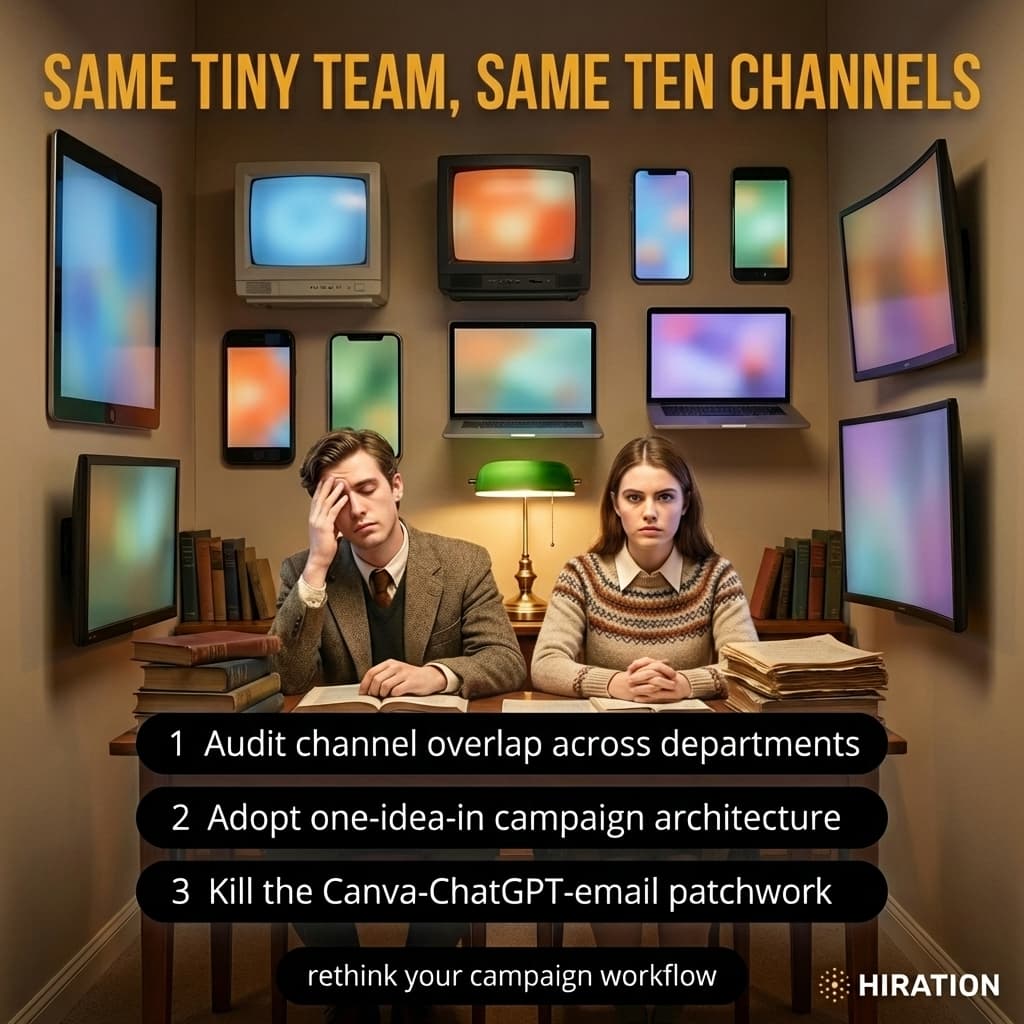
Picture this: it's eight weeks before Giving Day. Your two-person alumni engagement team needs a full campaign. Someone opens Canva to build social graphics. Someone else pastes a prompt into ChatGPT for email copy. A student worker uploads the wrong logo to Mailchimp. The director of annual giving writes landing page copy in a Google Doc that nobody reviews.
By launch day, you've got seven channels running with inconsistent messaging, three different visual treatments, and no clear call-to-action thread tying them together. The campaign looks like it was made by seven different organizations. Because, functionally, it was.
This isn't a failure of effort. It's what happens when you bolt together five free tools and call it a content strategy. Alumni relations teams at institutions with 30,000 or 300,000 alumni face this identically. The scale changes. The bottleneck doesn't.
What gets lost in the scramble? Donor psychology. Every extra minute spent reformatting a Canva template is a minute not spent thinking about why a 2019 graduate should care about the annual fund. Production work crowds out strategy work, every single time.
If your alumni team creates outreach content, Campaign Studio can save you a few hours each week.
See how it worksOne Idea In, Full Campaign Out
The teams getting better results aren't working harder. They're working from a different architecture.
Instead of building each channel's content separately, they start with a single campaign concept and expand it outward. One message. One visual identity. One emotional hook. Then they adapt that core across every channel simultaneously.
Here's what that looks like in practice for a young alumni engagement push:
- Define the single idea. Not "engage young alumni" but something sharper. "Your first gift matters more than its size." That's a campaign. The other is a category.
- Build the anchor asset. One email, one social graphic, one short video script. All built from the same brief, in one sitting, with one voice.
- Expand to secondary channels. Take that anchor and adapt it into a text message, an event landing page, a phonathon script, and a stewardship follow-up. The core message stays fixed. Only the format changes.
- Set the cadence before you create. Map out which channels fire on which days. A Giving Day campaign might run 14 touchpoints across 10 days. Plot those first, then fill them. Working backwards from the calendar prevents the "we forgot LinkedIn" problem.
This approach cuts production time dramatically because you're not inventing new content for every channel. You're translating one idea into different formats. That's a fundamentally easier creative task.
Audit Before You Add
Before building your next campaign, do something most advancement teams skip entirely. Audit channel overlap across departments.
Career services, alumni relations, admissions, and the president's office are often emailing the same graduates with different asks in the same week. At one mid-size university I've seen, alumni received four institutional emails in five days from four different offices. Nobody coordinated. Nobody knew.
A 30-minute cross-departmental audit reveals where you're duplicating effort and where you're competing with your own colleagues for attention. Sometimes the biggest win isn't a better campaign. It's fewer campaigns that actually get read.
Ask three questions in that audit:
- Which segments are hearing from multiple offices in the same two-week window?
- Are any departments running campaigns with overlapping goals that could be combined?
- Where are we using different tools to produce essentially the same type of content?
The answers usually point toward consolidation opportunities that free up hours every month.
Your Move This Week
Pull up your last multi-channel campaign. Count how many separate tools and separate sessions it took to produce all the assets. Write that number down. If it's above three, you've got a workflow problem worth fixing before your next Giving Day cycle starts. Build your next campaign from a single brief, in a single workflow, and see how much faster it comes together.
Frequently Asked Questions
How do small alumni relations teams create content for multiple channels?
Start with a single campaign concept and one anchor asset, then adapt that core message across each channel. This translation approach is far faster than creating original content per platform and keeps messaging consistent across email, social, text, and web.
What is one-idea-in campaign architecture?
It's a production workflow where one brief generates all campaign assets instead of building each channel's content separately. You define a sharp message, create an anchor piece, then systematically adapt it into every required format. Alumni relations and career services teams both use this to overcome small-staff bottlenecks.
How far in advance should you plan a Giving Day campaign?
Most successful Giving Day campaigns begin production eight to ten weeks out. Map your full channel cadence and touchpoint schedule first, then create content to fill it. Working backwards from the calendar prevents last-minute gaps and ensures no channel gets forgotten.
Why should alumni relations coordinate with other campus departments on campaigns?
Multiple offices often email the same alumni in the same week without knowing it, which tanks open rates and causes fatigue. A quick cross-departmental audit can reveal overlapping sends, shared audiences, and opportunities to combine efforts, freeing up time and improving engagement.
Your Alumni team is already doing this work manually
Campaign Studio turns one idea into a full campaign across Instagram, LinkedIn, email, Handshake, and LMS. Weekly engagement runs on autopilot. Event campaigns build on demand.
Run Your First Campaign