Career Center Time Management: 5 Ways to Reclaim Your Week
Visual by Campaign Studio · Generate your own for free
The average career center advisor spends roughly 60% of their week on tasks that don't require their expertise. Resume formatting, answering the same "how do I start" questions, chasing students for follow-up appointments. That's not a staffing problem. It's a systems problem.
And it's fixable without hiring anyone new.
Most Career Centers Optimize the Wrong Things
Picture this: it's March, your advising calendar is fully booked through April, and a line of students need resume reviews before a campus recruiting deadline on Friday. Your team of three is serving 4,000 undergrads, and everyone's triaging instead of advising.
The instinct is to work faster. Stay later. Squeeze in one more 15-minute slot. But speed isn't the issue. The issue is that high-skill advisors are spending hours on low-skill tasks. Formatting resumes into consistent templates. Walking a first-year through the same introductory career exploration exercise for the twentieth time that week. Manually sending appointment reminders.
None of that requires a master's degree in counseling. All of it eats the clock.
The career centers seeing the best outcomes aren't necessarily the biggest or best-funded. They're the ones that ruthlessly separate what needs a human brain from what doesn't. Then they build systems around that distinction.
If your career services team runs social campaigns, Campaign Studio can save you a few hours each week.
See how it worksA Week-by-Week Audit Changes Everything
Before you can fix the problem, you need to see it clearly. Here's a simple exercise that takes about 10 minutes at the end of each day for one week.
Keep a running list in two columns. Column one: tasks that required your professional judgment, empathy, or strategic thinking. A student navigating a difficult career pivot. A coaching conversation about interview anxiety. Helping someone connect their unusual major to a career path they hadn't considered.
Column two: everything else. The template formatting. The copy-paste email responses. The scheduling back-and-forth. The first-pass resume checks where you're mostly catching the same five errors.
After five days, add up the time in each column. Most advisors are stunned by the ratio. That gap between the two columns is your opportunity.
Five Shifts That Free Up Real Hours
Once you've identified where your time actually goes, these tactical changes can start reclaiming it within a single week.
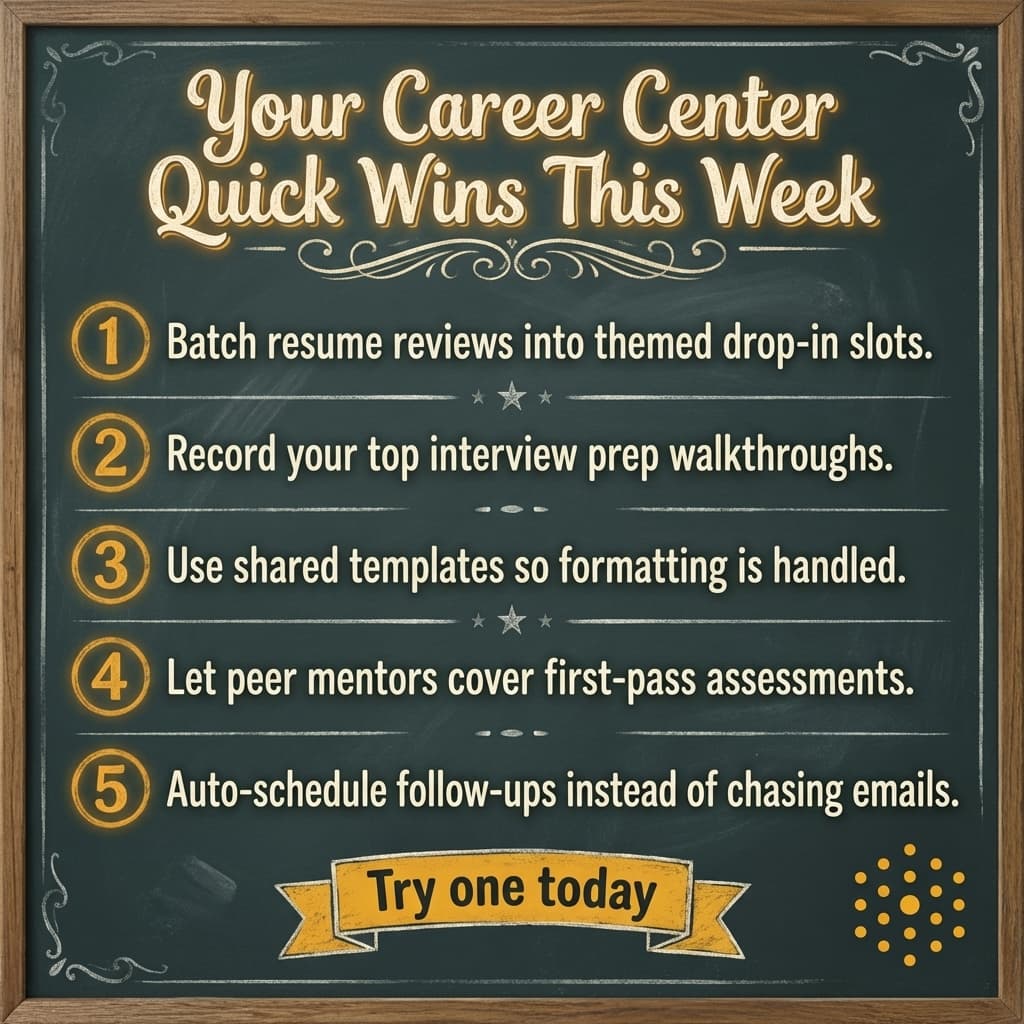
Batch resume reviews into themed drop-in hours. Instead of scattering 15-minute resume appointments across your calendar, run a 90-minute "Resume Lab" twice a week. Students get peer feedback from each other while you circulate. You'll review three times as many resumes in half the total time, and students learn by seeing others' work too.
Record your most-repeated advice. If you've given the same interview prep walkthrough 30 times this semester, that's a video waiting to happen. A 7-minute recording covering your top framework doesn't replace a coaching session. It replaces the first 7 minutes of every coaching session, so you can jump straight into the personalized stuff.
Build shared templates that eliminate formatting questions. A Google Drive folder with three resume templates, a cover letter skeleton, and a LinkedIn summary formula will cut your inbox volume noticeably. Students don't want to email you about margins. They do it because they don't have a better option.
Train peer mentors to handle first-pass assessments. Upper-class students who've been through the process make excellent front-line advisors for early-stage questions. They can run initial career interest conversations and flag students who need deeper support. Your role shifts from gatekeeper to supervisor.
Automate follow-up scheduling. Every minute spent in an email chain saying "Does Tuesday work? How about Thursday?" is a minute stolen from actual advising. Tools like Calendly or even your existing CRM's scheduling feature can eliminate this entirely. Set it up once, save hours every month.
The Compound Effect Is What Matters
Any one of these changes saves maybe 30 minutes a week. Combined, they can return 4 to 6 hours. That's an extra full afternoon of deep advising conversations, the kind where a student walks in uncertain and walks out with a plan.
And those are the conversations that show up in your outcome data. Students who receive meaningful career coaching are significantly more likely to secure employment or graduate school placement before graduation. The routine stuff doesn't move that needle. Your expertise does.
This week, try the two-column audit. Just five days of tracking. You don't need to change anything yet. Just look at where your hours go with clear eyes. What you find will tell you exactly where to start.
Frequently Asked Questions
How can career centers serve more students with a small team?
Focus on separating tasks that require advisor expertise from tasks that don't. Batch resume reviews into group drop-in sessions, train peer mentors to handle first-pass conversations, and use recorded walkthroughs for repetitive advice. A 3-person team serving 4,000+ students can significantly increase capacity without new hires by building these systems.
What tasks should career center advisors stop doing manually?
Appointment scheduling, resume template formatting, and introductory career exploration conversations are the biggest time drains that don't require professional expertise. Automating scheduling alone can save several hours per month, and shared templates drastically reduce repetitive student questions about formatting.
How do I track where my time goes as a career advisor?
Run a simple two-column audit for one week. At the end of each day, list tasks that required your professional judgment in one column and routine or repetitive tasks in the other. After five days, total the hours in each column to see exactly where your time is going and where systems could help.
Why are career center staff experiencing burnout?
Most burnout comes from spending the majority of the week on repetitive, low-complexity tasks like formatting resumes and answering the same starter questions, rather than the high-impact coaching work advisors are trained for. The mismatch between expertise and daily tasks creates frustration, especially during peak advising seasons in spring and fall.
Your Career Services team is already doing this work manually
Campaign Studio turns one idea into a full campaign across Instagram, LinkedIn, email, Handshake, and LMS. Weekly engagement runs on autopilot. Event campaigns build on demand.
Run Your First Campaign