June Summer Melt Prevention: A 3-Phase Email Sequence
Visual by Campaign Studio · Generate your own for free
Key Takeaways
- Most deposited students who melt don't tell you they're leaving. They just stop opening emails.
- A three-phase June sequence targets the specific reasons students ghost: logistics, money, and belonging.
- The teams preventing melt aren't sending more emails. They're sending the right ones each week.
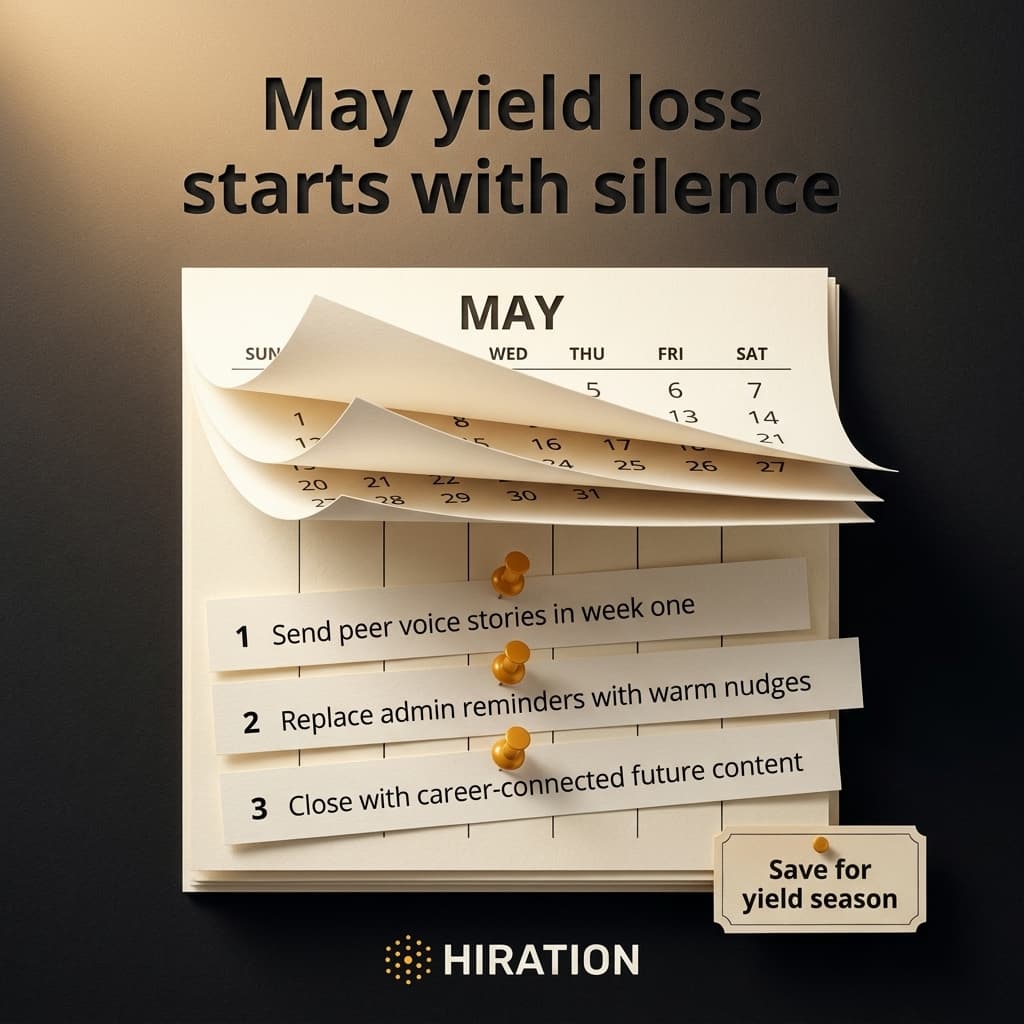
The single biggest mistake admissions teams make with summer melt isn't ignoring it. It's treating June as one undifferentiated block of outreach instead of three distinct psychological windows. A student's reasons for going silent in early June are completely different from their reasons in late June, and your email sequence needs to reflect that.
If your admissions team creates recruitment content, Campaign Studio can save you a few hours each week.
See how it worksWhy Most June Outreach Fails Before It Starts
Here's what I've watched play out across dozens of institutions. The deposit deadline passes. The team exhales. Then someone remembers that last year they lost a chunk of deposited students between June and August, and a flurry of "We're so excited you're joining us!" emails goes out.
Those emails aren't bad. They're just structureless. They land whenever someone has time to write them, which means they cluster around whatever the office's internal calendar looks like rather than what the student is actually feeling that week.
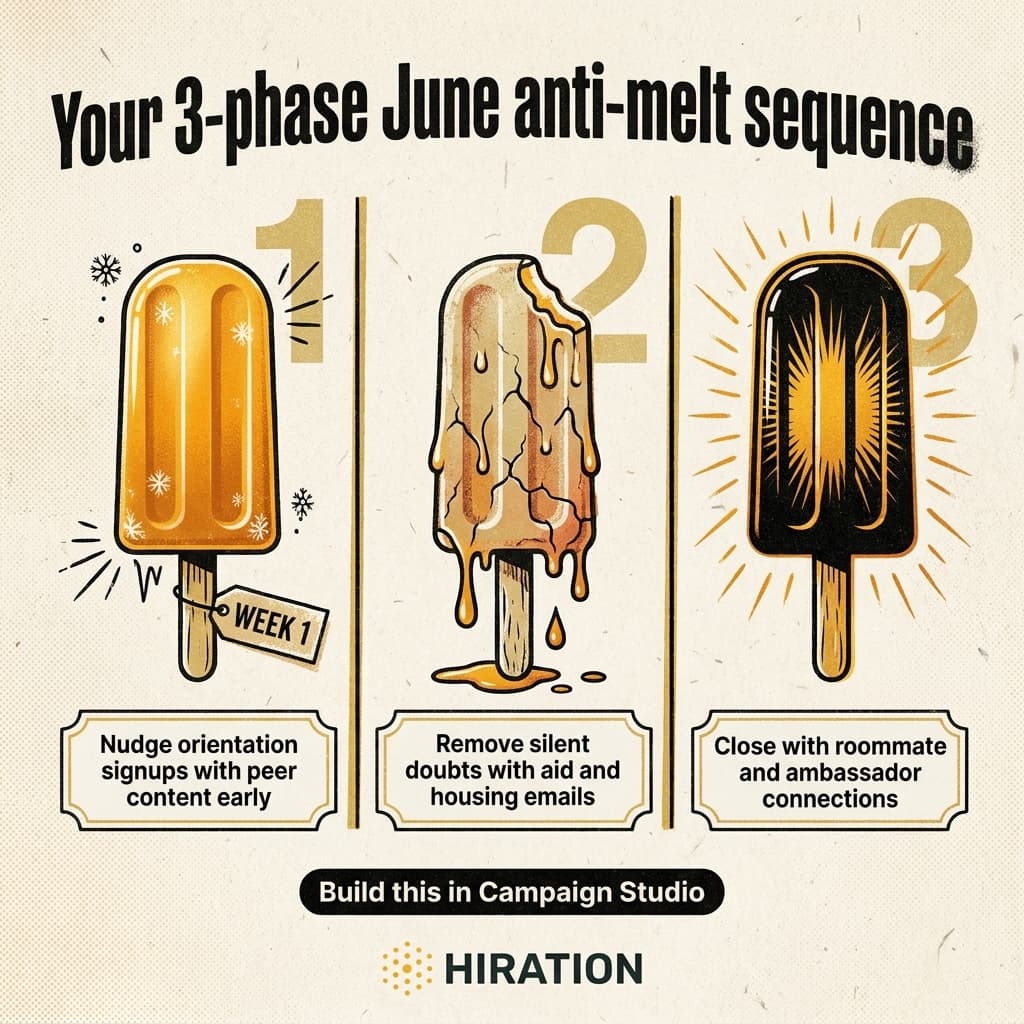
The teams I see holding yield through June do something different. They reverse-engineer their send calendar from the student's decision psychology, not from the office's task list. And they treat June as three phases, each targeting a different reason students quietly disappear.
| Phase | Timing | Student Mindset | Email Goal |
|-------|--------|----------------|------------|
| Phase 1 | June 1–10 | "Is this really happening?" | Make arrival feel concrete and inevitable |
| Phase 2 | June 11–20 | "Can I actually afford this?" | Remove silent financial and logistical objections |
| Phase 3 | June 21–30 | "Will I belong there?" | Create social ties that make reversing the decision painful |
This isn't arbitrary. It maps to how deposited students actually process their commitment over time. Early June is still abstract. Mid-June is when the bills arrive. Late June is when they either feel connected or start quietly reconsidering.
What Should Each Phase Actually Contain?
Phase 1 (June 1–10): Orientation nudges and logistics that make arrival real.
The goal here isn't emotional. It's operational. You want the student to take a concrete action that deepens their commitment. Orientation sign-up is the obvious one, but anything that involves a calendar entry, a form submission, or a decision about housing preferences works.
Send two emails in this window. The first is a peer-content email, not from the admissions office, but featuring a current student or recent orientation leader talking about what they wish they'd known before orientation. Video works, but even a short quote with a photo outperforms a branded graphic. The second email is a logistics nudge with a clear deadline. "Orientation slots are filling" is more effective than "Sign up for orientation!" because scarcity creates action.
What most teams get wrong here is tone. They go celebratory when they should go practical. A student who hasn't signed up for orientation by June 8 isn't lacking enthusiasm. They're lacking a reason to do it today.
Phase 2 (June 11–20): Financial aid clarity and housing transparency.
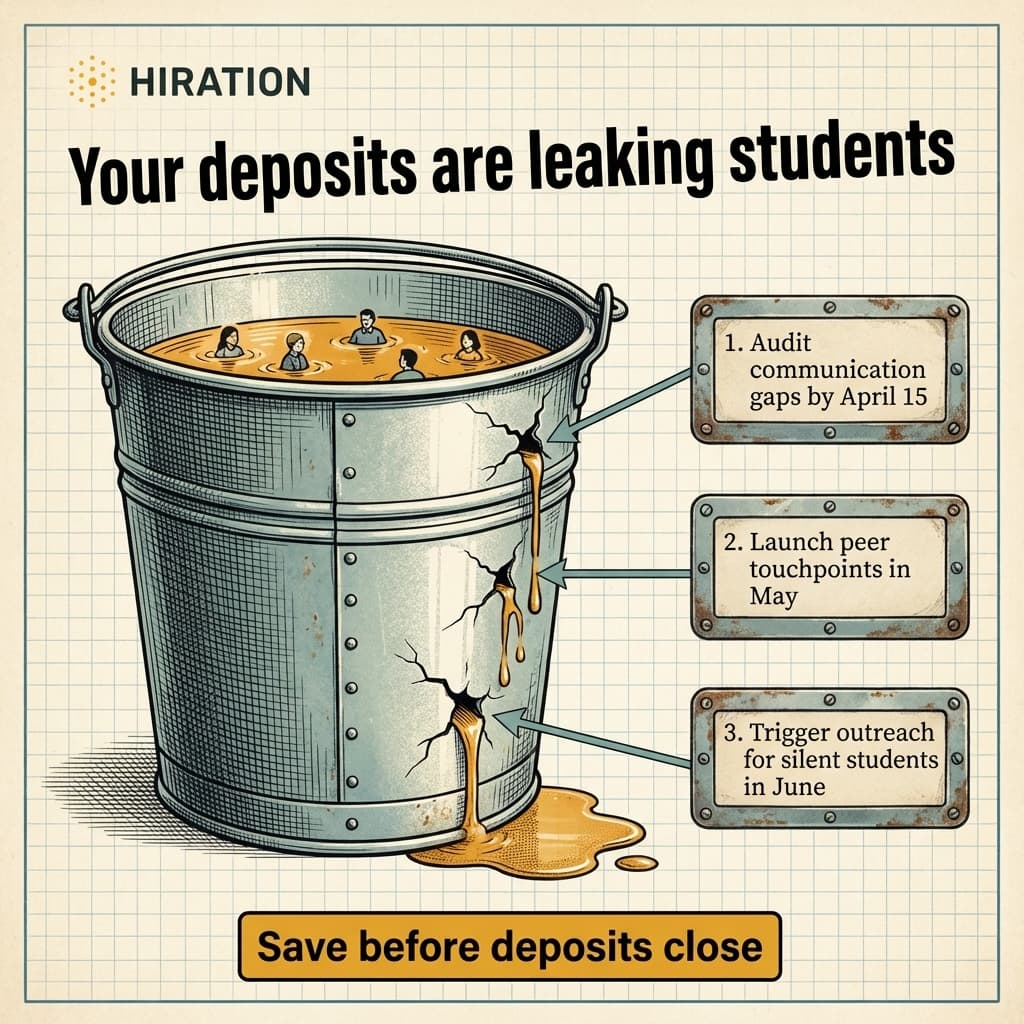
This is the phase most teams skip entirely, and it's the one that matters most. The silent objections that cause melt are almost always financial or logistical. A student gets their final aid package and the gap is bigger than expected. Their housing assignment feels uncertain. They don't understand their billing timeline. None of these students email you to say they're worried. They just disengage.
Send two to three emails here. One should proactively address the most common financial aid questions your office fielded last July (you're answering them a month early, which is the whole point). Another should clarify housing timelines, even if housing isn't your department. And consider one email that's just a direct line to a real person. "If anything about your fall plan feels uncertain, reply to this email. Rae in our enrollment office will get back to you within 24 hours." That kind of email doesn't scale perfectly. But the students who reply are exactly the ones you're about to lose.
I've seen offices resist this because it feels like admitting something might be wrong. But the institutions holding yield through summer aren't the ones projecting confidence. They're the ones removing doubt.
Phase 3 (June 21–30): Belonging content from ambassadors and near-peers.
By late June, the students still engaged have cleared the logistical and financial hurdles, or at least tolerated them. The remaining melt risk is social. They're scrolling another school's Instagram. Their high school friend just committed somewhere else. The decision still feels reversible.
Your job in the last ten days of June is to make it feel irreversible. Not through pressure, but through connection. This is where student ambassadors earn their keep. A short email introducing their future roommate or suitemate (if housing assignments are out). A message from a student ambassador in their intended major. An Instagram story takeover by a rising sophomore who looks like them, studies what they want to study, and is clearly having a good time.
Two emails and one social touchpoint work well here. The emails should come from peers, not from the institution. And the social content should be native to the platform, not a repurposed flyer.
How Do You Build This Sequence When You're Also Onboarding Orientation Leaders?
This is the real constraint, and I want to name it directly. June is when orientation leaders are being trained, summer programs are launching, and your team is probably down a person. Building a thoughtful six-to-eight email sequence across three phases sounds great in a planning meeting. Executing it while everything else is happening is a different problem.
The most effective approach I've seen is to build the full sequence in one sitting during the last week of May. Not drafting. Building. Subject lines, body copy, send dates, audience segments. All of it. Batch the creative work when you have focused time, then schedule everything to send automatically.
A typical build for a three-person enrollment team might look like this:
| Task | Estimated Time |
|------|---------------|
| Outline all 6–8 emails with phase goals | 30 min |
| Write email copy (batch all at once) | 90 min |
| Source peer content (ambassador quotes, photos) | 45 min |
| Build and schedule in your email platform | 45 min |
| Create 2–3 matching Instagram posts | 30 min |
| Total | ~4 hours |
Four hours in late May buys you an entire month of structured outreach. The alternative is seven separate scrambles across June, each one competing with orientation logistics for your attention. Most teams default to the second approach. Not because they prefer it, but because no one blocked the four hours in May.
Does This Work on Instagram Too, or Just Email?
Email carries the sequence. Instagram reinforces it. The phases map naturally to social content because each one has a distinct visual and emotional register.
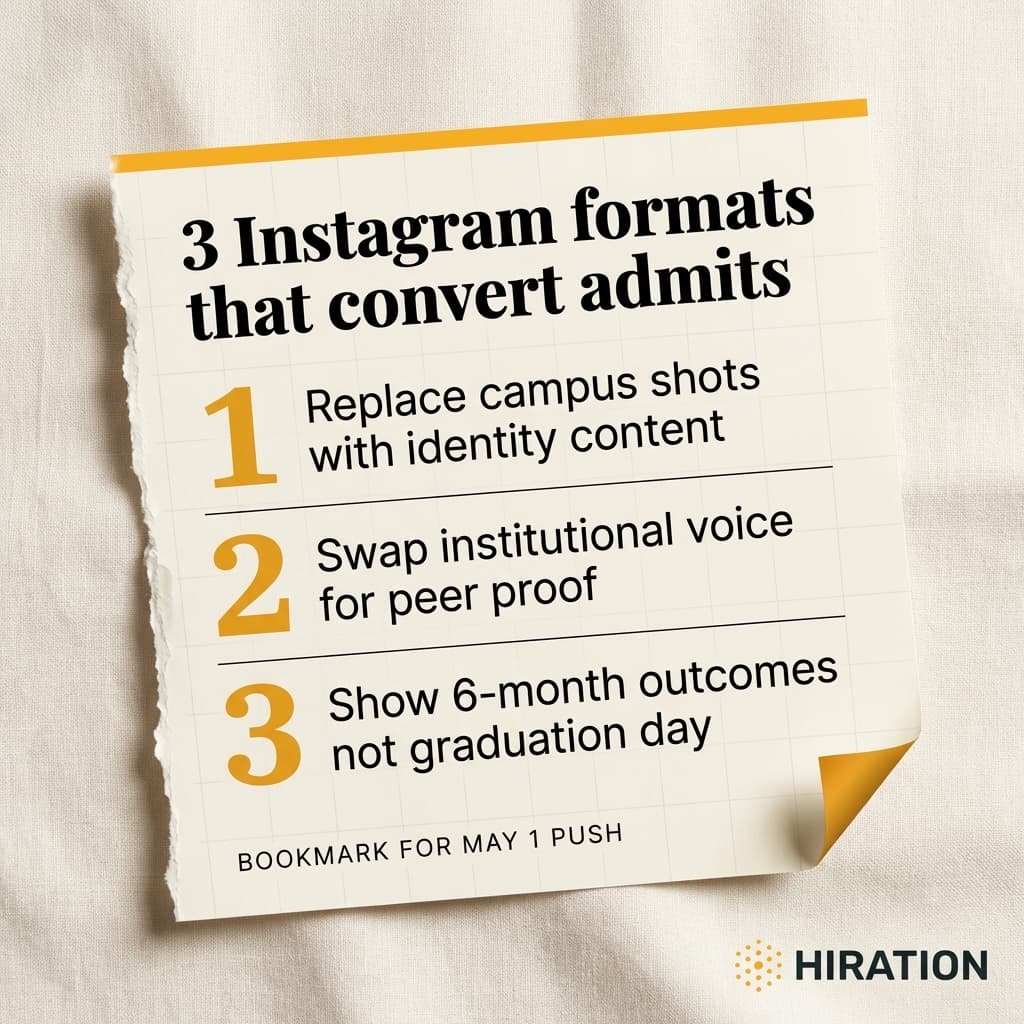
Phase 1 Instagram content is logistical and fun: orientation day photos, campus walk-throughs, "what to pack" carousels. Phase 2 content is reassuring: a quick FAQ graphic about billing, a reel from financial aid with one useful tip. Phase 3 content is social proof: roommate reveal reactions, ambassador day-in-the-life stories, admitted student spotlights.
You don't need to create separate content for every platform. But you do need to match the emotional phase. Posting a celebratory "Welcome Class of 2029!" graphic on June 22 when your email is doing the hard work of financial clarity creates dissonance. The students who are worried about their aid package don't want to see confetti. They want to see that you understand their situation.
One Thing to Do This Week
Block four hours on your calendar during the last week of May. Label it "June Anti-Melt Build." Open a blank doc, write three headers: "Make It Real (June 1–10)," "Remove Doubt (June 11–20)," "Create Belonging (June 21–30)." Draft two emails under each header. Schedule all six before you leave that session. Everything else, the Instagram content, the ambassador coordination, the housing follow-ups, layers on top of that foundation. But the foundation goes in first, or it doesn't go in at all.
Frequently Asked Questions
When does summer melt typically happen for college admissions?
Most summer melt occurs between June and August, after students have deposited but before classes begin. The highest-risk window is mid-June through mid-July, when financial realities set in and students who haven't formed social connections to the institution quietly disengage.
How many emails should admissions send deposited students in June?
Six to eight emails across June works well for most institutions, spaced roughly two per week. The key is varying the purpose of each email across logistics, financial clarity, and social belonging rather than sending repetitive celebratory messages.
What causes deposited students to melt over the summer?
The primary drivers are unresolved financial concerns, uncertainty about housing or logistics, and a lack of social connection to the institution. Most melting students don't announce their departure. They simply stop engaging with communications and quietly enroll elsewhere or decide not to attend college at all.
How can student ambassadors help prevent summer melt?
Student ambassadors create peer-to-peer connections that make a student's commitment feel social, not just transactional. Emails and social content from ambassadors in late June, especially those matched by major or background, help admitted students picture themselves on campus with people like them.
Your Admissions team is already doing this work manually
Campaign Studio turns one idea into a full campaign across Instagram, LinkedIn, email, Handshake, and LMS. Weekly engagement runs on autopilot. Event campaigns build on demand.
Run Your First Campaign