Alumni Marketing Plan Template for 2-3 Person Teams
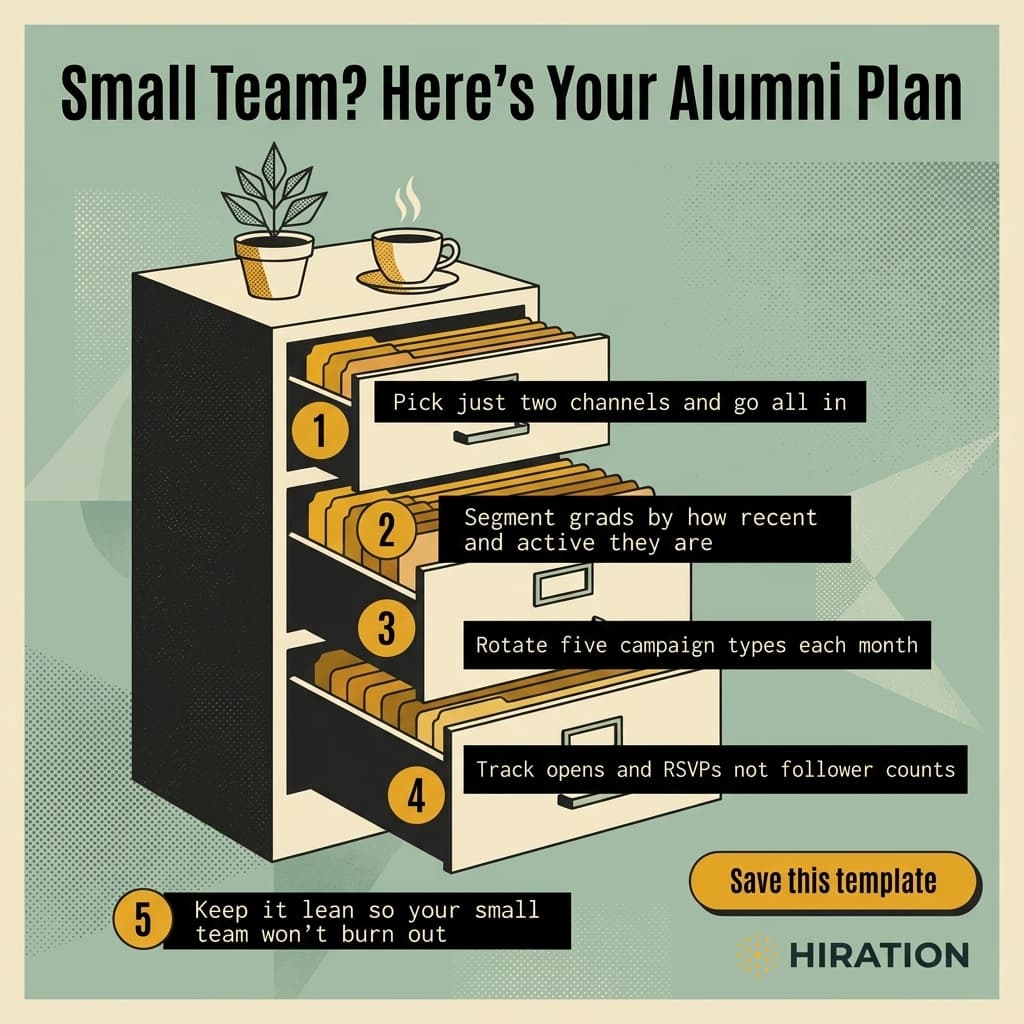
Visual by Campaign Studio · Generate your own for free
Key Takeaways
- Small advancement teams get better results from two channels than six. Pick LinkedIn and email, drop the rest.
- Five repeatable campaign types, rotated monthly, replace the blank-page problem with a system.
- Measure opens, clicks, and RSVPs. Impressions tell you nothing about alumni who actually show up.
The highest-performing small advancement teams I've watched over eight years don't do more. They do less, on repeat, and measure what matters. Here's a complete alumni marketing plan template built for the 2-3 person shop that can't afford to waste a single campaign cycle.
If your alumni team creates outreach content, Campaign Studio can save you a few hours each week.
See how it worksWhy Six Platforms Is Killing Your Alumni Engagement
Picture this. It's Tuesday morning. Your annual mentorship mixer is Friday. You need an Instagram post, a LinkedIn update, a Facebook event, a Handshake announcement, an email blast, and something for the LMS. Your marketing colleague is buried in admissions work until Thursday. So you open Canva, toggle to ChatGPT, start an email draft, and three hours later you've got content on six platforms that maybe 40 people will see.
I've seen this exact pattern at dozens of institutions. The instinct to be everywhere comes from a reasonable place. Alumni are scattered. Different age groups live on different platforms. But the math doesn't work for a small team.
When you spread across six channels, each one gets a fraction of your creative energy. Posts go up inconsistent. Some weeks you're active, some weeks you're dark. Alumni never build a habit of checking your content because there's no rhythm to find.
The teams that actually build engagement momentum do something counterintuitive. They cut channels. Aggressively.
Two Channels, Not Six: LinkedIn and Email
After working with advancement, career services, and alumni teams across more than 100 colleges and universities, I've landed on a strong opinion here. For a small alumni relations team, the right two channels are LinkedIn and email. Here's why.
LinkedIn is where your alumni already have a professional identity. They check it. They engage with career-adjacent content. And critically, LinkedIn's algorithm rewards consistent posting from organizational pages more than most teams realize. A well-timed alumni spotlight post on LinkedIn will outperform the same content on Instagram or Facebook for the audience you actually care about: employed alumni in their first decade out.
Email is your owned channel. No algorithm sits between you and your reader. You control the cadence, the segmentation, the call to action. And email is where RSVPs happen. Nobody RSVPs from an Instagram story.
What about Instagram, Facebook, Twitter/X? If you have a dedicated social media person, sure. But if you're a 2-3 person team covering giving, engagement, events, and communications? Those channels will get inconsistent attention, which is worse than no presence at all. A dormant Instagram page signals neglect. A focused LinkedIn presence signals intention.
| Channel | Best For | Effort Level (Small Team) | Alumni Response |
|---------|----------|--------------------------|----------------|
| LinkedIn | Spotlights, mentorship, career content | Medium: 2-3 posts/week | High engagement from young alumni |
| Email | Events, giving, newsletters | Medium: 2-4 sends/month | Highest RSVP and click rates |
| Instagram | Visual storytelling, student life | High: daily content expected | Low alumni reach without ad spend |
| Facebook | Events for older alumni segments | Medium | Declining organic reach |
| Twitter/X | Real-time updates | High: volume-dependent | Minimal alumni engagement |
The table makes the tradeoff visible. LinkedIn and email give you the best return per hour invested. Everything else is optional until your team grows.
What Are the Five Campaign Types Every Alumni Team Should Run?
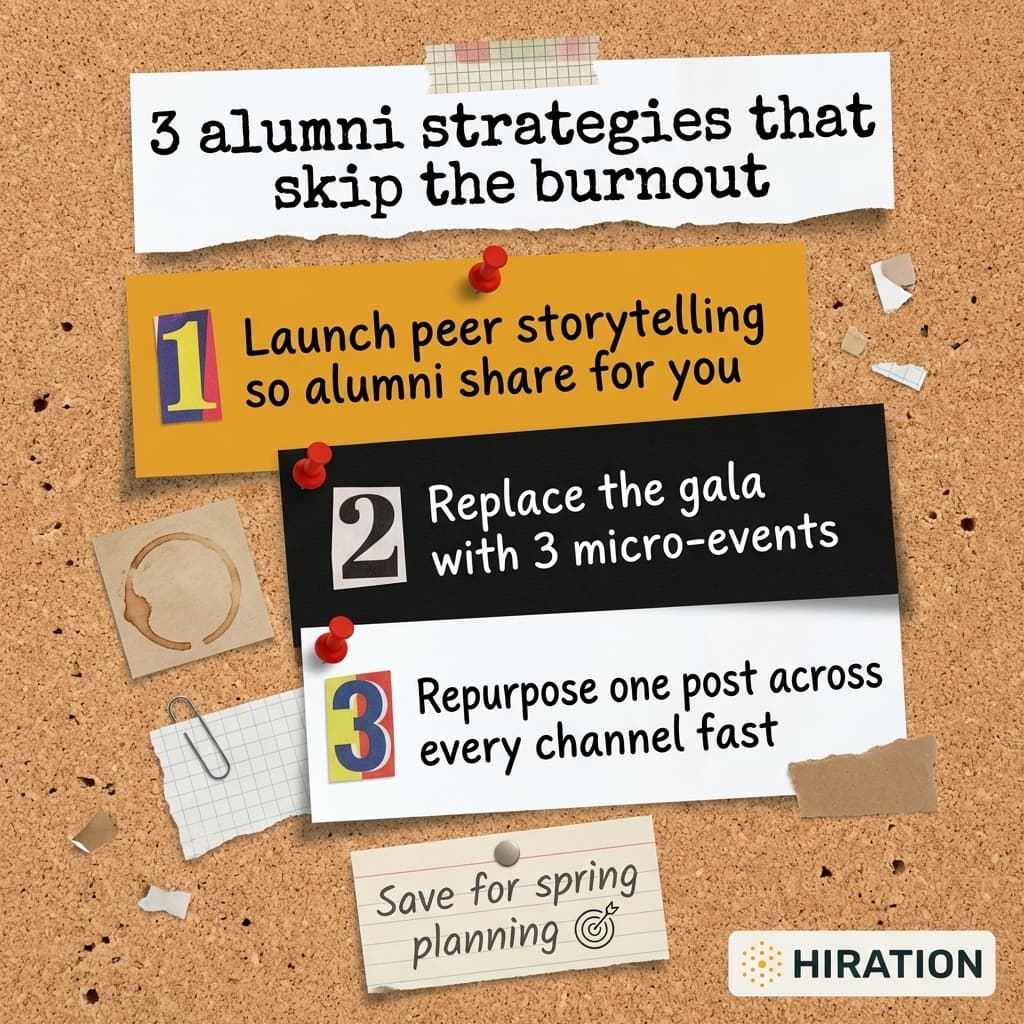
The blank-page problem kills more campaigns than lack of budget does. Every month, you're staring at a calendar wondering what to send. So here are five repeatable campaign types that cover the full alumni engagement spectrum. Rotate them. Don't reinvent.
1. Milestone campaigns. Class anniversaries, graduation dates, career firsts. "Congratulations to the Class of 2020 on five years since commencement." These are low-effort, high-warmth. Alumni love being remembered.
2. Event promotion campaigns. Your networking mixers, homecoming, regional meetups, webinars. Two emails (announce + reminder) and two LinkedIn posts per event. That's the whole sequence.
3. Mentorship and career campaigns. Connect current students with alumni mentors. Promote mentorship signups. Share career advice from alumni in specific industries. This is the content that makes young alumni feel like their university still adds value to their professional life.
4. Alumni spotlight campaigns. Profile one alum per month. Short Q&A, a photo, a quote about their path. Post on LinkedIn, include in email newsletter. These are your highest-engagement pieces because people share content about themselves.
5. Giving campaigns. Giving Tuesday, annual fund, specific program support. Most teams already run these. The difference is that when they're one of five types in rotation instead of the only thing alumni hear about, they perform better. Nobody wants a relationship that only asks for money.
A simple monthly rotation looks like this:
| Week | Campaign Type | LinkedIn | Email |
|------|--------------|----------|-------|
| Week 1 | Alumni spotlight | Feature post | Newsletter inclusion |
| Week 2 | Event promotion | Announce + reminder | Invite + RSVP link |
| Week 3 | Mentorship/career | Advice post or mentor callout | Signup CTA |
| Week 4 | Milestone or giving | Celebration post | Personalized note |
Four weeks, four types. The fifth type (whichever you didn't use) rolls into the next month. You never start from zero.
How Do You Measure Alumni Campaigns Without Vanity Metrics?
Impressions are the most dangerous number in alumni marketing. They feel good. "Our post reached 2,000 people." But reached means nothing if nobody clicked, opened, or showed up.
The three metrics that actually tell you whether your alumni engagement is working:
Email open rate. This tells you if your subject lines and send timing are right. If alumni aren't opening, nothing else matters.
Click-through rate. This tells you if the content inside is compelling enough to drive action. A clicked link is an engaged alum.
RSVPs and event attendance. This is the metric that connects to everything advancement cares about. Alumni who attend events are dramatically more likely to give, mentor, and advocate. Every team I've worked with that tracks the path from event attendance to first gift finds a strong connection.
Stop reporting impressions and follower counts to your VP. Start reporting how many alumni opened, how many clicked, and how many showed up. That's the story that matters.
The Career-Services-to-Giving Pipeline Is Real
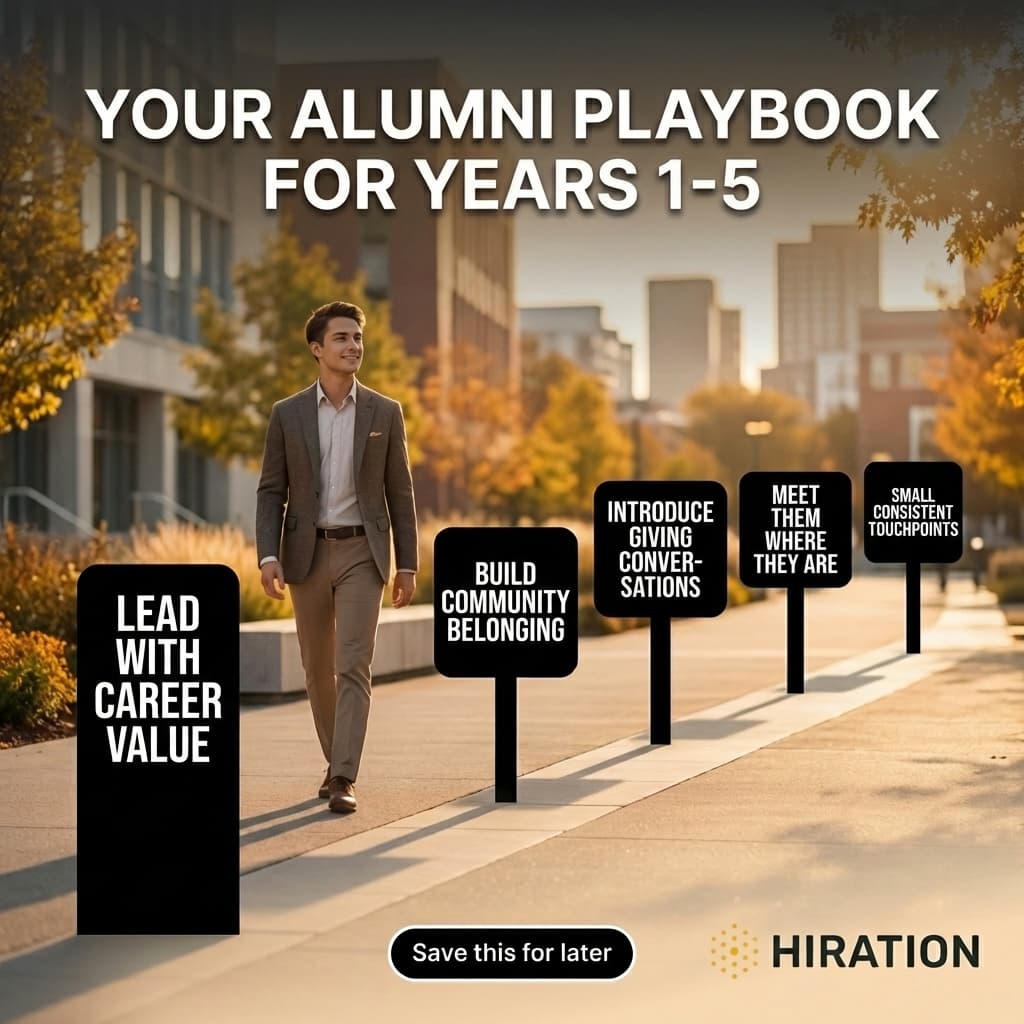
One pattern I keep seeing across institutions, and this is where small alumni teams leave the most value on the table. Young alumni who receive career value from their university in the first five years after graduation become donors and engaged alumni at significantly higher rates than those who don't.
Mentorship campaigns, career advice content, job board promotions. These aren't just nice engagement pieces. They're the top of your giving funnel. A 2019 graduate who got connected to a mentor through your alumni network in 2021 is far more likely to make a gift in 2025 than one who only heard from you on Giving Tuesday.
This is why the mentorship and career campaign type isn't optional in the rotation. It's the investment that pays off three to five years down the line.
How Does Campaign Studio Fit Into This Plan?
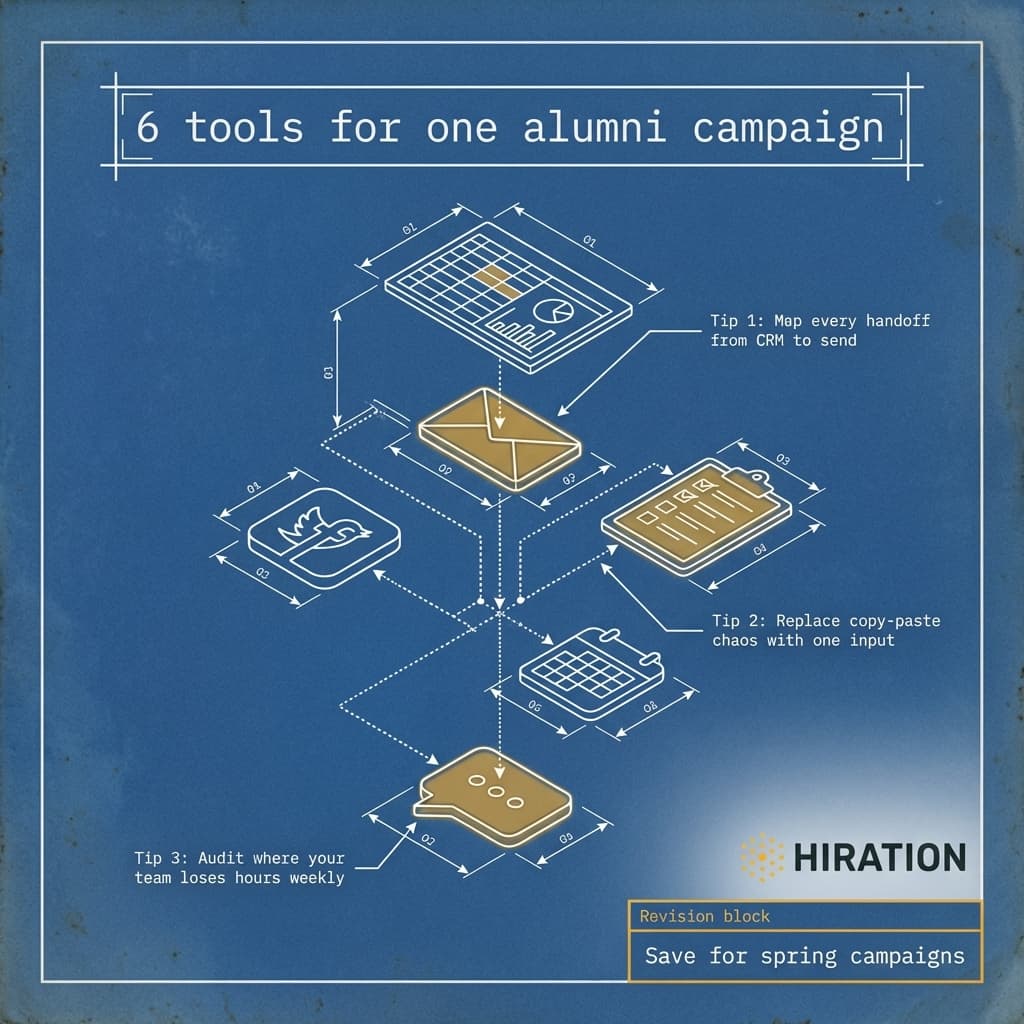
I built Hiration Campus because I watched too many talented 2-3 person teams burn hours assembling campaigns from a cobbled stack of Canva, ChatGPT, email tools, and shared drives. Campaign Studio turns one campaign idea into formatted content for LinkedIn, email, and any other channel in under 15 minutes. You pick the campaign type, feed it the details, and get publish-ready assets across channels.
That's not a pitch. That's the math. If your monthly rotation includes four campaigns across two channels, and each campaign takes two to three hours to build manually, you're spending a full workweek on content creation alone. Compress that, and your small team gets time back for the relationship-building that no tool can automate.
One Thing to Do This Week
Audit your active channels. Count them. If you're on more than two, pick the two that generated the most alumni responses in the last 90 days. Pause the rest. Not forever. Just until your two-channel rhythm is consistent and your open rates, click rates, and RSVPs are trending in the right direction. You can always add channels back. But you can't get back the hours you spent posting to platforms nobody was watching.
Frequently Asked Questions
How often should a small alumni team send email campaigns?
Two to four emails per month is the right range for most 2-3 person advancement teams. More than that risks fatigue without a content engine to sustain quality. Less than two per month makes it hard to build any reading habit with your alumni base.
What is the best social media platform for alumni engagement?
LinkedIn consistently outperforms other platforms for alumni engagement, especially with graduates in their first decade post-commencement. Alumni already have professional profiles there, and career-adjacent content like spotlights and mentorship posts gets natural engagement without paid promotion.
How do you increase young alumni giving rates?
Provide career value first. Alumni who receive mentorship connections, career advice, or job leads from their university in the first five years after graduation are far more likely to become donors. Build the relationship with career content before making the ask.
What should a small advancement team stop doing to be more effective?
Stop maintaining more social channels than your team can post to consistently. A dormant or erratic presence on Instagram or Facebook signals neglect and wastes hours that could go toward high-return work on LinkedIn and email. Cut first, add back later.
Your Alumni team is already doing this work manually
Campaign Studio turns one idea into a full campaign across Instagram, LinkedIn, email, Handshake, and LMS. Weekly engagement runs on autopilot. Event campaigns build on demand.
Run Your First Campaign